
scriptrix. hedge scholar. autistocrat
64 stories
·
0 followers

Why Are So Many Contemporary Novelists Not Naming the Narrator?

1 Share

Often, I don’t notice it: the nameless narrator. Because I write nonfiction, I rarely include my own name. Why would I? It’s right there. It’s only when I finish a novel and try to Google a question that I realize I don’t know how to search it. I’ve spent hundreds of pages with this character. I might know what sex they have and what sex they wished they had. More often than I’d like, I know their defecation habits. I might know things about them that no one in their life knows, but I don’t know the one thing about them that everyone knows. I have no idea what to call them.

If you, like me, enjoy plot-light, vibe-heavy novels, you’ve probably spent a lot of time with unnamed narrators. In 2015, the phenomenon was widespread enough for Sam Sacks to label it an “epidemic” when he traced its history in the New Yorker. And it hasn’t slowed down in the years since. Nameless narrators show up in some of the most discussed literary fiction of the past few years: Audition by Katie Kitamura, Transcription by Ben Lerner, My Year in Paris with Gertrude Stein by Deborah Levy, and, most recently, Life of M by Rachel Cusk.

Of course, these only represent one species of nameless narrator. The convention is also popular in apocalypse novels, where social systems that make names useful have collapsed; in Christian allegory, where all of humanity is implicated; and in thrillers, where withholding a name can set up a plot twist. But I see these as separate lineages from the ones I keep running into: narrators wandering around a city, isolated not by the fall of society, but their own ruminations. To be clear, I enjoy these books, and I think brooding on the subway is cool and fun. I don’t mind the nameless narrator as a convention. I just don’t know what they want from me, or what they’re asking me to notice.

*

Names are often proxies for identity, and the same can be said for their absence. In Rebecca, one of the most famous examples, the second Mrs. de Winter is unnamed, and her lack of a fixed self is arguably the novel’s central wound. She imagines herself mostly as a replacement for the first Mrs. de Winter, Rebecca—a woman who, by contrast, has a name and agency so overwhelming that she titles the book. Audition, too, explores the instability of self, narrated by an unnamed actor who seems to experience two consciousnesses at once: “Not a splitting of personality or psyche, but the natural superimposition of one mind on top of another mind.”

I don’t mind the nameless narrator as a convention. I just don’t know what they want from me, or what they’re asking me to notice.

One common reading is that anonymity serves as a vessel the reader can step into—an idea sometimes linked to Everyman, the Christian allegory, and, more recently, to Everyman, the Philip Roth novel. But I’m not sure how effective that is. For me, at least, it isn’t the presence or absence of a name that keeps me from identifying with the narrator of Fight Club, so much as the fact that I don’t want to be punched in the face.

I think of a friend who once said he struggles writing fiction because he always gets stuck on the names. As soon as you choose one, he said, you implicitly lock in all this other information: age, ethnicity, gender. Our other friends teased him about this: surely he’d have to know something about his own characters. Did he expect to write a person outside of time, with no race, background, or relationship to gender, and expect that to resonate with anyone? This is, of course, the paradox: leaving out specificity creates a sense of vagueness, while universality is built in detail. If anything, a withheld name collapses the distance between narrator and author—not narrator and reader. When a text is plausibly autofiction, the name often serves as a dial the author sets for how autobiographically we’re meant to identify the character with the writer.

But then maybe I’m getting off track. Maybe I’ve been distracted by the question of how namelessness reshapes the narrator’s identity, and forgotten the other half of it.

*

Here’s something that matters: these nameless narrators actually do have names.

The narrator of Rebecca, for example, has one that we’re told is “lovely and unusual.” Maxim knows it. The staff at Manderley know it. It’s only the reader who is left in the dark, unable to see the narrator through the eyes of another person. A name is, after all, the simplest way someone exists for others.

The withheld name, then, marks a shift in narrative position as much as it does identity. It’s not that the character is “everyone” or “no one,” or even “the author,” but that their external form isn’t revealed to us. The story is shot from a camera mounted on the narrator’s chest.

It’s probably relevant that I started reading a run of contemporary nameless-narrator novels right after I finished Mrs Dalloway, and then listened to a bunch of podcasts about modernism.

Mrs Dalloway is in many ways the quintessential modernist text, using free indirect discourse to approximate the movement of thought. But before modernism emerged, the nineteenth-century realist novel dominated. These books were told by an omniscient narrator who observed characters from the vantage point of God. It was a stable intelligence surveying a world that could, at least in theory, be comprehensively known. But secularization, industrialization, and the horror of World War I interrupted old ways of thought. Freud was stoking enthusiasm about the subconscious and interior realities. An objective God’s-eye-view no longer seemed quite right, and so, modernism’s inward turn began, and the novel’s world was filtered through the individual. More and more, the camera moved inside the character.

All this—modernism, names, the visual scope of a novel—was already on my mind when I started reading Transcription, and so I saw it everywhere. The unnamed narrator’s 90-year-old mentor gestures toward the possibility that the self is created, at least in part, when it’s seen by someone else: “Did you know all melanin is brown,” the mentor asks, “It is how the light strikes the iris, how it is reflected to the eyes of the other, that gives them color.” If a name is the tool by which we conceptualize the other, removing it obstructs that external vantage point. Should the narrator’s eyes be blue, they will never be blue for us.

It seems like the question—are we looking or being looked at?—has a fraught cultural valence right now, at the same time as our narrators are losing their names.

If the modernist novel lets readers inside consciousness, the unnamed narrator continues this project by refusing to let the reader step back outside of it. Conveniently, my next book, My Year in Paris with Gertrude Stein, was a novel in which an unnamed narrator researches modernist pioneer Gertrude Stein. When the narrator writes about Stein, the desire to escape the vantage point of the others seemed core to Stein’s mission:  “If we create ourselves with and through language, it seems to me that Gertrude Stein’s project was to dismantle herself and a whole century through language, to uncreate herself as she had been created by her father, by her sneering professor at Johns Hopkins, by her brother, to undo the manner of the nineteenth century.” What faster way to shed the self someone else chose for you than by shedding a name?

But today’s authors aren’t twentieth century modernists. In My Year in Paris with Gertrude Stein, Levy writes about the limitations of trying to describe a new era with an older century’s vocabulary: “Every century needs an artist to dismantle coherence as we have been taught it and make a space for something new to happen.” As Stein’s work was shaped by her own changing century, the nameless “epidemic” is borne of this one.

What is it about our world that inspires novelists to write this way? Transcription is largely a book about the way that technology “structures experience even when quiet.” And there’s something to be said about that—the way that smartphones and social media make us conscious of the distance between the person we experience ourselves as being and the person others see. There’s also the fact that as work and daily life become less communal, the self becomes something we define privately. I’ve seen a million cat memes screaming “PLEASE DO NOT PERCEIVE ME!!!” It does seem like the question—are we looking or being looked at?—has a fraught cultural valence right now, at the same time as our narrators are losing their names.

The unnamed narrator is inherently mysterious, resistant to being fully known. But I know what happens when I read them, or rather, when I realize after the fact that I never learned their name: my eye is drawn off the page, and the narrative walls become visible. I become more aware of what was held back, that there is always something held back from me.

Read the whole story
KristenHG
10 hours ago
reply
Share this story
Delete

Medicare for All: Separating the slogan from the substance

1 Share

People are fed up with the U.S. health care system, and rightfully so. Medical premiums and debt are rising, clinicians are burned out, and patients have less access to care. As another election approaches, these conditions are building up, just waiting to ignite change like wildfire.

Is the solution Medicare for All? It remains a bumper-sticker topic in several local congressional races. This is somewhat unsurprising, given that many Democrats think it’s the answer and even some Republicans support it. But when it comes to politics, slogans tend to leave out nuances.

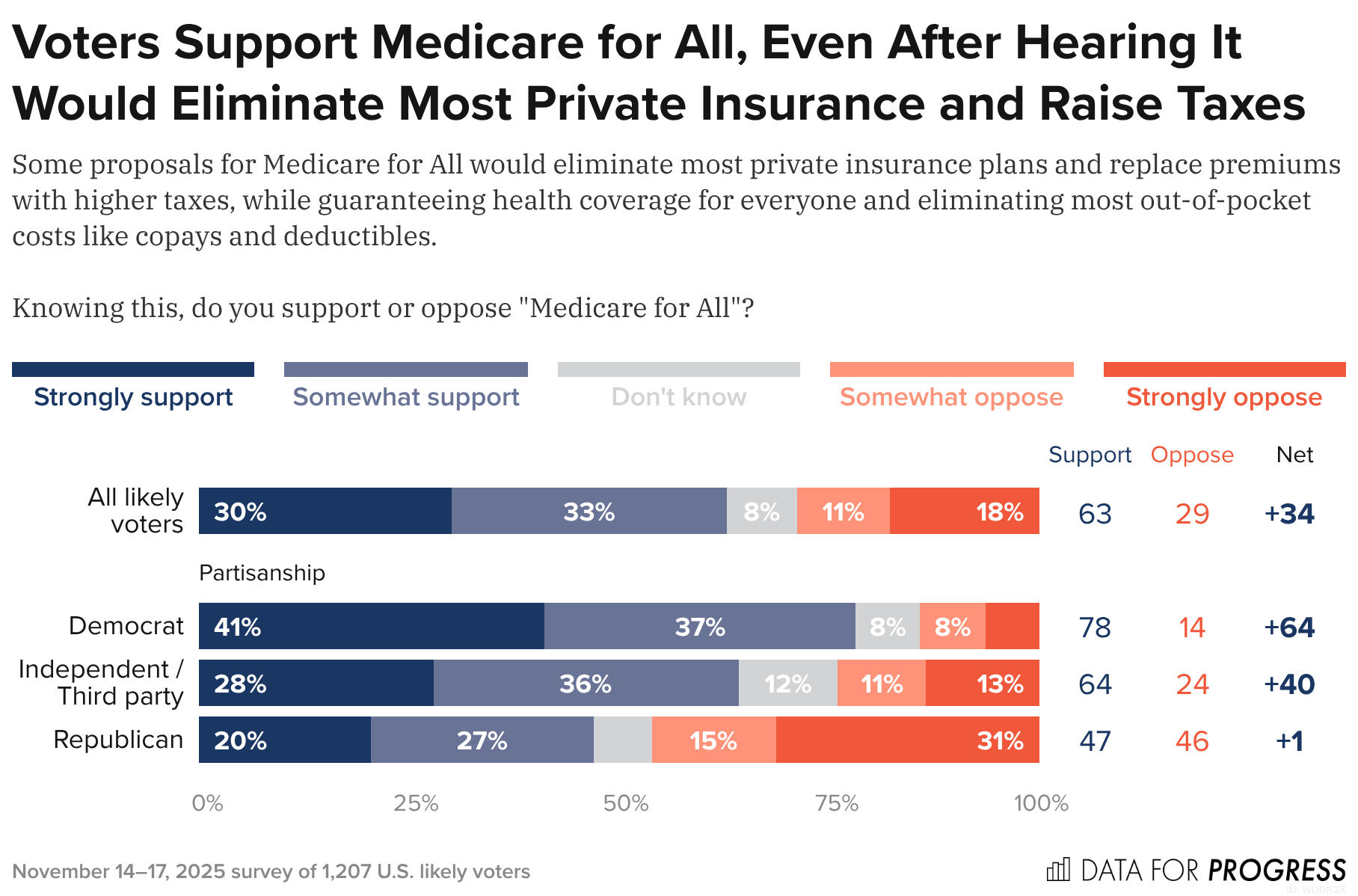
Medicare for All Is Popular — Even When Put Up Against Attacks

So I called Hayden Rooke-Ley, a professor of health policy and lawyer, to join me and weigh in on the practicalities of what could be the biggest change in health care since the passage of Medicare and Medicaid in 1965.

Can we actually afford Medicare for All?

This is the first question everyone asks. And the answer is yes.

The U.S. currently spends more on health care than any other country, with private insurance driving the highest costs. That’s why most experts think Medicare for All would lower overall healthcare spending.

But what society can afford differs from government financing. Fully funding this without going into debt requires significant new taxes. Convincing Americans to send more money to the IRS is a hard sell, even if the argument is that they’d stop sending money to insurance companies.

That said, when you tally it all up, roughly 70% of the U.S. health care system is already financed by taxpayer money. So the real question is less about whether we want taxpayers financing the health care system. We largely already do that. It’s more about how we want to do it.

Would it even look like “Medicare”?

Since the early 2000s, Medicare has been divided into the traditional government program (Original Medicare) and Medicare Advantage. Advantage plans offer the same benefits as Original Medicare plus extras like drug, dental, or vision coverage, but this privatization is known to cost taxpayers an additional $100 billion (!) a year. Meanwhile, seniors on Original Medicare need to buy a separate private plan for any extra coverage.

Medicare has other issues. It leads to overpaying specialists, subsidizing large corporate hospital systems, and leaving drug price negotiation to private plans and pharmacy benefit managers (PBMs).

Medicare for All advocates envision a single, all-inclusive plan with no extra fees or private insurance. This would replace all current programs and set new federal rules for taxes and coverage, making it a way bigger change than just expanding Medicare as it is now.

Would it fix the “broken” fee-for-service system?

U.S. health policy has long viewed high health care costs as the result of overutilization due to the fee-for-service model, where clinicians are paid per test or procedure. This has led to cost-containment measures that reduce use of services, like high deductibles, hospital and insurer consolidations, and prior authorization requirements.

But Americans don’t generally use more health care than people in other wealthy countries. In areas such as primary care, they may even use too little. The bigger reasons U.S. health care costs so much are higher prices for care, high billing and insurance overhead, and spending on costly drugs and treatments that offer little added benefit.

So rather than identifying the problem as fee-for-service and trying to manage utilization, Medicare for All would attack the core drivers of high costs head-on—mainly the prices and the administrative bloat. It’s a very different approach to cost containment.

Could it help small doctors’ offices?

It could.

This part doesn’t get talked about much. Big hospital chains and private equity rollups can charge insurers more than small medical practices can. That’s due to their negotiating power, not the delivery of better care, which forces small clinics to sell to larger chains.

If everyone had the same government insurance with the same set prices, that advantage would disappear. Small, independent clinics could survive without needing to merge into giant systems. Providers would compete instead on quality of care.

This doesn’t mean that corporate health care goes away overnight. Some Medicare for All proposals ban for-profit facilities like hospitals, but many nonprofits have become corporate. This means we need policies to regulate their governance and accountability, regardless of future reforms.

What about rationing and waiting in line for care?

People often say, “if we get government health care, we’ll have to wait forever for treatment, like in other countries.”

Is that true? Not really. U.S. wait times for primary care are longer than in peer countries, on average. While specialty care may take longer elsewhere, access also varies. U.S. access to specialists is quicker than in Canada, but Germany and France have shorter wait times for elective surgery and specialty care. Overall, Americans have the worst access to care among 10 peer nations.

Medicare for All could improve access to care, depending on its goals. Wait times are policy decisions.

But more so, Medicare for All tries to address rationing of access that already exists within the system. Medicaid pays providers much less than private insurance, so fewer doctors accept it, and 27 million Americans remain uninsured. In rural areas, sparse or spread-out populations can make hospitals and clinics financially difficult to sustain, leaving residents with fewer local care options.

High deductibles and copays can lead even insured people to skip unaffordable care. This gets worse every time employer health care costs go up: rising premiums are a flat, regressive tax, eating disproportionately into the wages of lower-income workers.

Medicare for All tries to address these access problems by covering everyone, making care free (or very cheap), and making everyone “worth” the same to providers.

It’s still only a piece of the puzzle.

Medicare for All would certainly be transformative, but changing insurance financing by itself won’t address many of the system’s issues, such as primary care shortages, medical school debt, financialization throughout the system, and much, much more.

And those are just the concerns in the medical system. We know that most of what affects health actually occurs outside of the exam room. That gets into the realm of public health and how our society tackles issues like poverty, education, and access to resources.

But here, Medicare for All plays an underappreciated role because it provides a mechanism for weighing priorities democratically. It allows us to decide whether to allocate more funds to health care versus social programs, for example, and creates a unified budget that we can titrate accordingly.

Bottom line

The U.S. needs solutions to its ridiculous health care costs. No solution will be easy, and no solution will fix it all. Whether the current health care landscape will reach a breaking point that makes Medicare for All a politically viable option at the federal level remains to be seen.

But it does feel like this country is at its tipping point. About time.

Love, YLE and HR-L


Hayden Rooke-Ley, JD, is Assistant Professor at the Brown University School of Public Health. His scholarship focuses on corporate consolidation in health care, Medicare and Medicaid financing, and labor and workforce issues in the health sector. He has published in leading journals, including the New England Journal of Medicine and Journal of the American Medical Association (JAMA), and he advises state and federal policymakers, enforcement agencies, and other health care stakeholders. He is a licensed attorney in Oregon and earned his JD from Stanford Law. His work can be found on X and LinkedIn.

Your Local Epidemiologist (YLE) comprises a team of experts, ranging from physicians to immunologists to epidemiologists to nutritionists, working together with one goal: to “translate” ever-evolving public health science so that people are well-equipped to make evidence-based decisions. The YLE suite of newsletters reaches over 475,000 people across more than 132 countries. This newsletter is free to everyone, thanks to the generous support of fellow YLE community members. To support the effort, subscribe or upgrade below:

Subscribe now

Read the whole story
KristenHG
25 days ago
reply
Share this story
Delete

In Portland, Violence Interrupters Struggle to Keep a Steady Foothold

2 Shares

This story first appeared in Bolts, and is republished with permission.

In 2020, when Fernando was shot twice in the street outside the old Portland Meadows Racetrack, where he was working as a construction flagger, it was actually fortuitous that he tore a tendon in his knee while trying to run away. He says that’s the reason he crumpled to the ground, and probably why the rest of the gunshots missed him. Construction workers erecting an Amazon warehouse in the old racetrack’s place called 911 as he lay on the ground, and then he was rushed to Legacy Emanuel Medical Center in northeast Portland. 

Fernando’s wife Shauna, their two kids, and other relatives arrived at the emergency room in agony, frantically trying to learn of his condition. Amidst their anxiety, a familiar face came to visit them. 

Hiag Brown helps run a community violence intervention program called Healing Hurt People, which sends case workers like him to quickly respond to Portland hospitals when they receive gunshot victims. Before rushing to Legacy Emanuel the day Fernando was shot, Brown had already met Shauna and others in her family because of because of the group’s outreach work during other incidents of gang violence that have affected her family in the past. (The family asked that Bolts only use their first names to protect their privacy.)

After the shooting, Brown and other workers with Healing Hurt People became a near constant presence in the lives of Shauna, Fernando and their two boys. They checked in with the family daily, connected them to support services like counseling and job training, and also helped them cover essentials like utility bills.

Shauna says they became a stabilizing force for her family during that scary and chaotic time, and that the group has even continued to support them in the years since. She says they were especially good at supporting her boys as she was worrying how they might react to their father being a victim of gun violence. She says she had already been concerned about raising them in an area that had seen other shootings and gang violence, even before their dad was shot. 

“I’m sure you can just imagine how that could turn a good kid bad,” she told Bolts. 

Their youngest son, who was 15 when his father was shot, is now a young adult with a commercial driver’s license, which Shauna says he obtained because of help the family got though Brown and others with the program.

“A lot of time when you’re looking for help or services or anything you have to reach out and, in this instance, we never had to reach out,” Shauna told Bolts. “Hiag consistently checked on us.” 

Healing Hurt People is an example of the kind of violence intervention program that some communities have long tried to establish to provide more than just a police response to gun violence. The Portland program, which follows a model pioneered in Philadelphia nearly two decades ago, is one of at least 77 hospital-based violence intervention programs operating across the country. 

And like many other violence intervention programs, it has struggled over the years to keep its footing because funding is continually in jeopardy.

Proponents of these kinds of programs say they represent a more comprehensive response to shootings that better supports victims than simply tracking down and potentially prosecuting the perpetrator—an approach that they argue can help prevent retaliation and more violence. For Brown and other caseworkers, that often means helping shooting victims and their loved ones get counseling, housing assistance or job training after meeting them in the hospital and helping them get through those first frightening days. 

The research into this kind of community intervention has been limited but mostly promising. Violence interrupter programs like Cure Violence appear to be one of the most studied models and have been associated with reductions in violence in several cities. Hospital-based intervention programs have also been associated with reductions in violence.

Even so, studies have also concluded that the effectiveness of violence interrupter programs can vary depending on a number of factors like funding, buy-in from “credible messengers” who can reach people at the highest risk of violence, as well as the competence and integrity of people running the programs. Experts also typically caution that a number of other factors can also affect violent crime and make it difficult to know how much of a role any particular intervention may play. 

In Portland, Brown told Bolts that he’s witnessed how the approach can help defuse the potential for violence. “You now have somebody that can walk you through that process of helping you disengage from the gangs and walk away, and how you do that in a respectful way to where you don’t become a target because you’ve gotten out of the lifestyle,” he said.  

Healing Hurt People launched in the city in 2013 as part of a community mental health care group called Cascadia Behavioral Healthcare, a nonprofit providing services across the region like walk-in crisis centers and supportive housing. But five years later, Cascadia could no longer financially support their work as the service provider struggled to stay afloat. 

Brown says he was one of only two outreach workers meeting with shooting victims in the hospital around the time COVID hit, as Portland and other cities across the country saw an uptick in violence. And due to the lack of funding, Brown says he was mostly volunteering his time. 

Brown says the group—which has since gone under the wing of the Portland Opportunities Industrialization Center (POIC), the local chapter of a nationwide workforce training organization—has taken major steps in recent years to bolster their work, including by partnering with Portland State University to evaluate and standardize training for its community safety workers. 

Soon after launching, Healing Hurt People started sending on-call outreach workers to respond to Legacy Emanuel, a hospital in northeast Portland where shooting victims often end up. Then around 2022, the group also began sending people to the Oregon Health & Science University (OHSU) hospital in Portland, as part of a partnership with researchers at the school’s Gun Violence Prevention Center to study hospital-based responses to gun violence. 

That means the group is now integrated into the care teams at both of Oregon’s top-level trauma centers and quickly gets access to victims’ names and initial information about the shooting, including medical status or even what room they’re in, which often helps them act as an intermediary for loved ones in the community. The group says that hospital access also gives them the opportunity to rapidly connect shooting victims and their families with more support, and helps inform any further outreach in the community to try and prevent future violence.

Kathleen Carlson, director of the OHSU center that’s working with Healing Hurt People, told Bolts that having a program that meets shooting victims in the hospital and stays with them after discharge could help direct more attention to other issues that can have an impact on gun violence. People could get connected to counseling that helps them address other traumas, or they could receive help accessing services that allow them to move out of an unsafe living situation. 

“Really it is a humanistic approach,” she said. 

In 2022, supporters of these programs scored a major win when Oregon lawmakers earmarked $5 million in state grant funding to help expand their work and grow similar programs outside the Portland metro area. Legislation passed that year also allowed the group to start billing Medicaid for work with shooting victims who are enrolled. 

Roy Moore, who was integral in securing Medicaid funding for Healing Hurt People and is now co-director of POIC’s community care team that oversees its work, says the program currently has four hospital-based outreach workers who work full time and who are supported by a host of others on POIC’s community care team. 

“When you’re vulnerable like that, it’s easy to feel like there’s nobody looking out for you.”

Kolby Ross, gun violence survivor

While they would like to expand this work, funding still always seems precarious. For instance, the Trump administration last year terminated grants aimed at community safety and violence intervention programs nationwide, which Healing Hurt People and its university partners had intended to use to fund more research into their work and improve training for outreach workers. 

“Slashing of all the federal funding of programs that didn’t meet the new administration’s priorities really sets us back by years in terms of being able to grow our team and our capacity to do that kind of work,” Carlson told Bolts.  

The drying up of federal grant funding also coincided with a city proposal to reduce funding for violence prevention programs this year, as Portland grappled with a $172 million budget deficit.

The budget initially proposed by Mayor Keith Wilson this past spring would have cut future grants the city’s Office of Violence Prevention gives out by $1 million—grants that support POIC’s violence intervention work. It also proposed significant cuts for other police alternatives, including downsizing Portland’s behavioral and mental health crisis response team. 

Around the same time, city officials issued a press release praising the city’s Office of Violence Prevention for helping Portland lead the nation in reducing gun violence in recent years. The statement cited a report listing Portland among the cities that have seen the steepest declines in shootings since the height of the pandemic.

After advocacy from the affected groups and a show of support from the community, council members made budget amendments to restore nearly all of the funding the mayor had proposed to cut from the city’s Office of Violence Prevention. 

Council member Sameer Kanal, who voted for the budget amendments, said he thinks such programs are a necessary part of the public safety network. “There are types of calls that need an armed police response and types of calls that need a traditional firefight response, but then there are other calls that go to those two responders because we don’t have built out structures that are tailormade for those types of lower acuity calls,” he told Bolts. “We need the right responder available for each call.” 

As they support shooting victims, Healing Hurt People outreach workers do sometimes have to coordinate with police. But Brown stresses how they’ve tried to adopt policies that make it clear to both victims and the police bureau that they are not part of, or working for, law enforcement. 

This has meant drawing some bright-line rules with police; for example, if police are in the hospital room speaking with a victim, their community safety workers are not. “We are not part of the investigation, so we’ll step out so they can do their job,” Brown told Bolts. “They stay in their lane and we stay in ours,” Brown said. “We collaborate, but we’re not best friends.” 

Kolby Ross was 23 when he first met community workers with Healing Hurt People inside a Portland hospital in late July 2022, after a bouncer at a downtown club shot him three times. The bouncer, who was working with an expired gun license, said he was firing at someone else who had shot at him first. 

Ross says that the difference between how Healing Hurt People made him feel and how the police and prosecutors treated him after the shooting could not have been more stark. “The police kind of forced themselves into my room and made me give a statement while I was under pain medications,” he told Bolts. He also stressed that the way the Multnomah County DA’s office questioned him while he was in the hospital felt “overwhelming and it re-traumatized me.” 

“When you’re vulnerable like that, it’s easy to feel like there’s nobody looking out for you,” Ross told Bolts. “I feel like the DA kind of did a good job of trying to isolate me in that moment so that he could get what he wanted out of me.” After the DA’s office declined to indict the shooter on any charges, Ross says officials never explained to him why. 

Ross couldn’t get around on his own after he was shot, let alone work. After he was released from a hospital in a wheelchair, Ross relied on case workers like Isiah Bailey with Healing Hurt People for mobility. Bailey was part of the first cohort of community safety workers who graduated from the training and accreditation program that Portland State University worked with the organization to develop. Prior to his injuries, Ross also didn’t have secure housing that he could return to after leaving the hospital. So Bailey worked to get him set up in an apartment while the group paid for his first month’s rent. 

Just as importantly, Ross says that Bailey also helped him figure out how to navigate the intense feelings he was having after the shooting. “Once I started feeling really anxious going out to places, he was really the only person I could come to,” Ross says. 

Bailey told Bolts that providing “access to mental health services,” is a big part of the work they do, adding “there’s a lot of stigma, especially in the brown and Black communities, about mental health and how to address mental health,” but sees part of his role as normalizing that access and those conversations.

The post In Portland, Violence Interrupters Struggle to Keep a Steady Foothold appeared first on Portland Mercury.

Read the whole story
KristenHG
30 days ago
reply
Share this story
Delete

Art by Humans, For Humans: A Letter from Our Editorial Director

1 Share
Art by Humans, For Humans: A Letter from Our Editorial Director

Dear Reader,

The New York Times recently asked dozens of 10-year-olds what the world will be like in 2050. Some are hopeful: a woman will finally be president of the U.S., people will be more kind, and everyone will have a pet fox. Others, though, feel as if they’ve been plucked straight from a dystopian hellscape: world wars, monarchic rule supplanting voting, embedded brain sensors that send your thoughts straight to an app, and the end of human civilization entirely. Whether optimistic or not, these children mention A.I. again and again. In their futures, it’s an inextricable fixture of life.

A.I.’s exponential growth has accelerated fears about its power, prompting numerous executives and technologists to warn that it’s time to slow such rapid expansions. Whatever your feelings, it’s clear that we’re collectively witnessing a moment that will shape our world for generations.

For artists, illustrators, designers, and writers like me, A.I. is not only a threat to our livelihoods but to the very substance of our humanity. The question is not whether a bot could create a technically proficient painting or describe a sculpture with more insight than I could, but rather about what we lose from outsourcing the singular technology that is ours. Art is uniquely human and one of the greatest drivers of empathy and connection with one another. As I’ve come to understand, it’s also a true act of faith in a world that can make hope feel impossible.

For the past seven years, I’ve spoken with thousands of curious and creative people striving each day to draw attention to the misunderstood, the overlooked, and the unimaginable. Artists are uniquely primed to envision alternative ways of being, and in their profound acts of generosity, they share their hopes for the great and small with us. Their faith, in turn, becomes something we can all take part in.

Colossal operates on generosity, too, propelled not by an algorithm or an A.I. model but by a devoted team of just four people. We strive to ensure that the widest array of readers, from students and educators to fellow creatives and art appreciators, have the opportunity to engage with artists’ work they might not otherwise encounter. We also prioritize a deeply human process. Every facet of the magazine, from selecting images to writing headlines to compiling our daily newsletter, is done with our hands. 

Although we certainly could be more efficient if we automated and outsourced our efforts, we know that would be the end of what makes Colossal what it is. We understand that in embracing friction, we’re supporting the artists, illustrators, designers, and more who have so generously shared themselves and their dreams with us. We’re also actively creating the world we want to live in.

But we can’t do this alone. An intentional and people-powered process like ours requires real resources, and less than 0.5% of our weekly readership financially contributes to Colossal. Increasing that support to 1% would mean cementing our long-term survival and ensuring we can continue to celebrate the unbridled human creativity that has come to characterize the magazine for the last 16 years.

Becoming a Colossal Member is both an act of generosity and a direct line to the work that matters. Colossal Members believe in the power of creativity and have faith that it can help usher in a better tomorrow. When there’s a rapid shift to sleek, frictionless life, they champion the nuanced, messy, and idiosyncratic, and the art that can only be made by humans, for humans.

Yours in hope,
Grace Ebert
Editorial director, Colossal

Do stories and artists like this matter to you? Become a Colossal Member today and support independent arts publishing for as little as $7 per month. The article Art by Humans, For Humans: A Letter from Our Editorial Director appeared first on Colossal.

Read the whole story
KristenHG
30 days ago
reply
Share this story
Delete

The Conveniences I Used to Write a Book About Inconvenience (Definitely Not AI)

1 Share

After a few months, I got used to the sarcasm. If I told a friend I was writing a book called Against Convenience, they’d ask whether I was planning to write it by hand, whether I’d use spell-check, or if I would prefer they read an AI summary or order the book from Amazon.

The jokes wrote themselves. The book did not.

To be fair, I do have twee collections of pencils, fountain pens, and typewriters. But I had no plans to abandon digital tools to write the book. I’ve never written anything longer than a journal entry by hand, my spelling is awful, and the typewriters only get used to label food trays for parties. I need the internet to research. And I knew from the beginning I would make heavy use of video calls, since only one person I wanted to interview lived in the same country as me, and he was an hourlong train ride away.

People using it weren’t saving that much time or effort.

Still, I was aware of the potential for hypocrisy with any time-saving invention I deployed, and I wanted to avoid the results of using them—either the public embarrassment of being found to have taken high-tech shortcuts or the private guilt of knowing I didn’t practice what I polemicized. So as I mapped out my research plan and chapter outlines, I also put together a technology plan, deciding which tools were in or out. As I wrote, more tools fell out than I expected; many of the basic digital tools I’ve used for years have degraded in quality over the last decade. They were rarely better than what they replaced, only occasionally easier, and never cheaper. Sadly, not all of them were optional.

To start, there was research. Even if it hadn’t been rendered mostly useless by AI and advertising (the twin enshittifiers of most online tech), web search was never going to be enough for the amount of research I needed to do. I got a library card at the University of Basel and spent some time talking to a librarian about how to access various databases and use interlibrary loan.

This led to my first decidedly inconvenient writing routine. Every morning, I took the bus to campus and left my laptop behind. On a public computer terminal, I pulled up Zotero—a miraculous and free program that stores and organizes research material. After a couple hours of pulling articles, I zigzagged through the library’s creaky wood-floor stacks pulling books (I liked to wear hard-soled shoes on these days to get a satisfying click as I walked). The main reading room is where I first turned to a personal digital device; I used my phone camera as a portable scanner. At the end of the week, I’d talk with my wife about what I learned—getting her thoughts and making up for the long hours I’d spent alone in the library.

As I was doing this, I increasingly heard friends and former colleagues say they were using AI for research and brainstorming. Most of these conversations included an admission that the bot’s claims needed to be checked for hallucinations, that prompts had to be rewritten several times to be effective, and that the feedback tended to be positive and surface-level. When I was in a better mood, AI seemed like a natural evolution I was stubbornly resisting. My tech was a way of speeding up a slow process, too: I was using computers and a digital camera instead of flipping through card catalogs and photocopying pages.

But the more I learned about AI’s needs and shortcomings, the less it seemed like the same size of a forward leap as Zotero or the web. People using it weren’t saving that much time or effort. They didn’t have to take the bus and study books, but they were still reading and writing. The AI was a middleman between their brain and the draft, and they went into their work with mistrust of a machine instead of curiosity over a concept. And as for the half-hearted feedback…there are plenty of humans who can offer that.

When I moved from books to human sources, machines were a constant disappointment. Sources I wrote to often responded a week or two later, apologizing because my message had gone to spam. I started my career as a reporter in a time when many people posted their office phone numbers online. A cold call easily led to an interview. Now, if someone does list a number, they never answer it (would you?). When we finally met on a video call, the first minute or so was lost to working out bugs in our connection and making sure my software was recording properly. Tech compressed the distance between me and my sources, but phones had done that almost a century ago, with a better quality and consistency. I got so frustrated with lag and dropped connections, I considered adding a section to the book about what we lost in reliability and fidelity when calls became digital, but I had plenty of other tech to take on.

The only AI-adjacent tool I used in writing was an old one: an app that transcribed interview recordings. The process is nothing like using a chatbot; I feed the machine audio files and it spits out text. Automated transcription has advanced significantly, but errors are still common, and it’s no substitute for listening back to the tape. Even an accurate text transcription doesn’t capture the tone of a conversation—it doesn’t tell you if a person is being sarcastic, for example, and pasting from a transcript could take someone out of context. The most useful element of a transcript is that it makes an interview searchable—for the many times I remembered someone I spoke to said something about digital photography, fast food delivery, or labor economics, but I couldn’t remember who or what, exactly, what said.

When I clicked on it, hoping this time I’d see how to turn it off, it offered to summarize and rewrite, encouraging me to not think about the document at all.

As I organized my WAV files and their corresponding text documents into folders, I remembered a documentary I’d seen on the Rolling Stone writer Ben Fong-Torres. His basement was full of shelves of interview tapes. Every interview I’ve ever done in my career was done on a digital recorder. Maybe one day, there’ll be a documentary about me, where I sit in front of a big monitor showing a computer folder.

My transcription service also offered an AI-written summary of calls, which were only good for a laugh. The summaries have the stiff, cautious tone of a book report written by a student who only watched the movie. Lines like “the conversation emphasized the need for a balance between convenience and human creativity” and “Speaker 2 raised concerns about algorithmic bias and its influence on consumer behavior” are technically accurate, but obvious. There was nothing specific or incisive, just a waste of computing power to tell me—I’m Speaker 2—what I already knew.

For drafting, I stuck to my standard process for long articles and essays. I outlined by hand on paper, then used a mind-mapping program to attach and order quotes, points, and research. Zotero helpfully spat out Chicago-formatted citations that I attached as endnotes to relevant sentences in Scrivener. I understand how authors wrote books with typewriters or pencil and paper, but the thought of managing hundreds of citations and endnotes without copy-paste—or at least a rudimentary word processor—seems like a nightmare.

This setup worked well as long as it was just me editing files on my own computer. Once I moved away from my closed-loop tech world, enshittification was unavoidable. To trade drafts with my editor, early readers, publisher, and fact-checker, I needed to install Microsoft Word. The latest version required a subscription. In the app, Microsoft’s AI assistant, called Copilot, hovered over the page. Its logo was a splash of color in a sea of white and black. My eye was drawn to it. When I clicked on it, hoping this time I’d see how to turn it off, it offered to summarize and rewrite, encouraging me to not think about the document at all. Even more insulting was the cold, transactional nature of the intrusion. Copilot’s instructions were sentence fragments—basic commands.

Things got worse when we moved to proofs. I hadn’t used Adobe Acrobat in years, mostly because it was too cluttered with pro features compared to the native Mac app. But Acrobat was the only software I was allowed to use to review page layouts. What once seemed powerfully professional now seemed like something meant for a kid’s my-first-tablet device. Every time I opened the manuscript, Acrobat offered to summarize it, and a sidebar suggested I ask AI “what stands out most in this document.” As a design decision, this makes less sense than Copilot’s editing tips. Acrobat is used to review documents and manuscripts, yet the primary feature suggests I not do that at all.

He writes that a new tool should be cheaper, smaller, and more energy-efficient than what it replaces.

These options might not be so troublesome if they were truly optional. I have no choice but to use Word and Acrobat. And the features are impossible to ignore. Software—or any tool—should enable work, not bully someone into a specific behavior. The tools suggest that the thousands of words I had typed were meaningless—that inefficiency was the curse of human communication. An odd message for programs built for communication, used widely in writing and publishing.

I fantasized about asking AI to assess the parts of my manuscript that critique AI, crummy design, and the generally infantilizing and insulting treatment we users get from tech companies. Maybe my argument was so strong, the AI would realize that its tech overlords were using this insanely powerful technology not to solve hunger or climate change, but to make reading less essential. Maybe it would see that it was being used to eliminate creative work and instead create an army of tiny bosses, each standing over a machine and telling it to think. Maybe it would turn against its creators. But I know enough about AI to know it would never do anything so inspiring. So after I sent my final draft and couldn’t change anything in the text, I let my sick desire for punishment overpower my better angels, and I asked Copilot to offer some tips. Above a warning that “AI-generated content may be incorrect,” Copilot wrote:

Overall, this is a sophisticated, voice-driven manuscript with a strong central argument, but its impact would improve if the early promise, chapter architecture, and recurring examples were tightened around clearer reader navigation and sharper argumentative escalation.

It’s pablum that’s equal parts soulless and nonsensical (how can a promise be tightened?). The idea that something so poorly written is meant to improve prose makes me think the literacy crisis is centered in Redmond, Washington. At least Clippy had some cartoony panache. I can’t decide if the idea that this might replace a person—let alone a professional like my wonderful editor—is more insulting to me as a writer, or as a human being.

I imagined what would happen if I had followed the AI’s commands from the beginning—use Copilot to condense, use Acrobat to generate an AI summary, paste it into my email and send it. What if my editor accepted the nudge in an email app to summarize further? Could we get to a summary so efficient that it was only a single sentence? Maybe just one word? Would the burden of thought be so lightened that we don’t need to do anything beyond eat protein bars brought to us by DoorDash while signals bounce between servers and screens occasionally assure us our work is being done?

As I wondered this, an Acrobat pop-up took over my screen. Did I want to upgrade to pro?

Throughout this process, I kept turning to a small book I kept on my desk: the Penguin edition of Wendell Berry’s 1987 essay “Why I Am Not Going to Buy a Computer.” I found it accidentally, looking through shelves in the basement of a used bookstore.

The center of the essay is a list of standards Berry applies to technology. He writes that a new tool should be cheaper, smaller, and more energy-efficient than what it replaces. “It should do work that is clearly and demonstrably better.”

Unlike Berry, I find the computer necessary in my work. It makes my research possible and keeps the copy editor sane. But much of my computer use wasn’t anything I could reject. There weren’t land-line phones to call people on, shelves of printed journals with the articles I needed, or a physical card catalog in the library. There was no alternative to Word or Acrobat that would work in the situations I needed. The mandatory software only made a job possible—not better, not less frustrating, and not any more rewarding. I plan to uninstall Word and Acrobat now that the book is done. Hopefully I’ll have a reason to install them again, and when I do, maybe the AI will be easier to ignore. For now, I’ll close my laptop and keep it closed for a while.

__________________________________

Against Convenience by Gabe Bullard is available from Hanover Square Press, an imprint of HarperCollins.

Read the whole story
KristenHG
33 days ago
reply
Share this story
Delete

Black Holes or Black Hole Stars? Astronomers Spar Over Webb Telescope’s ‘Little Red Dots.’

1 Comment

Astronomers built the James Webb Space Telescope to pick up faint light from the first billion years after the Big Bang, a chaotic era when vast swaths of hydrogen and helium gas gathered into the chains of galaxies we see today. Even in the telescope’s first images, astronomers could see a whole zoo of mysterious smears of light. One batch of objects proved especially difficult to interpret.

Source


Read the whole story
KristenHG
34 days ago
reply
Clearly these should be called black hole suns.
Share this story
Delete
Next Page of Stories