Castro (Barbie, 9-1-1) will receive the Humanitarian Award for his commitment to community, education and creating opportunities for others through culinary arts. Reilly (American Horror Story, Obi-Wan) is set for the President’s Award, recognizing exceptional contributions to the property craft by a professional outside the traditional property master role. The Lifetime Achievement Award will go to Wilkinson (Titanic, eight Harry Potter films), celebrating a remarkable career spanning more than four decades and some of the most iconic films in British and international cinema. Read more about them below.
“The MacGuffin Awards are about recognizing the people whose creativity, generosity and dedication help define our craft, both on set and beyond it,” PMG President Jeffrey Johnson said. “Luis, Trish and Barry each represent a different and invaluable part of what makes the property community so special. Their careers and contributions reflect the skill, ingenuity and spirit that we are proud to celebrate.”
Watch on Deadline
The MacGuffin Awards honor the creative excellence and impact of prop masters across film, television, commercials and more.
Here are mini-bios on the 2026 career honorees, provided by the Property Masters Guild:
Luis Castro, Humanitarian Award
Born and raised in Puerto Rico, Luis Castro moved to California at 15 and developed a passion for the culinary arts. He earned an Associate of Arts degree in Culinary Arts & Restaurant Management from Los Angeles Trade–Technical College and spent more than 25 years in the food industry as an executive chef, private chef, culinary instructor and restaurant owner.
Over the past decade, Castro has transitioned into food styling for film and television. A member of IATSE Local 44 since 2021, his credits include This Is Us, Westworld, 9-1-1, Bel-Air, Paradise and Barbie.
In 2024, Castro founded Imagine Cookin, an in-home cooking class company serving neurodivergent individuals of all ages. The program uses culinary education to build confidence, independence, creativity and life skills while introducing students to potential careers in the culinary arts. Now employing eight people and serving 50 students, Imagine Cookin reflects Castro’s commitment to creating opportunities and empowering others. He also volunteers to advocate for authentic Latinx representation within the industry.
Trish Reilly, President’s Award
A lifelong love of cooking and a deep familiarity with the motion picture industry have shaped Trish Reilly’s career as a food stylist. Born in Montreal and raised in Toronto, Reilly moved to California as a teenager, inspired by her mother’s passion for cooking. Her connection to production also began early through her husband, key grip Dan Reilly. She started her career assisting on commercial shoots before quickly establishing herself as a skilled and inventive food stylist.
Reilly works at the intersection of props and food, creating inventive and often unconventional culinary elements for the screen. Her credits include Obi-Wan, Rebel Moon and The Orville, as well as the gruesome culinary creations of Grotesquerie and drinkable blood for American Horror Story.
Her work regularly calls for ingenuity, precision and close collaboration with Property Masters and production teams, whether creating paleo dog food for an actor or an apple pie with no apples. Her creativity, passion and unwavering commitment to perfection have made her a distinctive and valued contributor to the property craft.
Barry Wilkinson, Lifetime Achievement Award
Barry Wilkinson retired following more than 40 years in the property department, during which he worked on more than 70 films, serving as Property Master on many. His credits include Titanic, Indiana Jones and the Temple of Doom, Who Framed Roger Rabbit, two James Bond films, including GoldenEye, and all eight of the original Harry Potter films.
In recognition of his extraordinary career, Wilkinson received the BAFTA Lifetime Achievement Award and was presented to Queen Elizabeth II at a reception honoring individuals who have made significant contributions to British film.
Throughout his career, Wilkinson collaborated with some of the industry’s most celebrated filmmakers and performers, including James Cameron, Steven Spielberg, Marlon Brando, Bruce Willis, Robert Mitchum and Julie Andrews. His four decades of work span some of the most influential productions in British and international cinema, leaving a lasting legacy within the property department and the wider filmmaking community.
Read More About:
Subscribe to Deadline
Get our Breaking News Alerts and Keep your inbox happy.
By continuing to use our services, you agree to the PMC Terms of Use, including waiver and arbitration. PMC, its service providers, and third-party partners process information about you and how you use our services, including clicks and screen recordings, using first and third-party cookies, pixels, and similar technologies. Where applicable, you can opt out of certain uses of cookies via the Your Privacy Choices link in our footer. Learn more about our data practices in our Privacy Policy.
Your Privacy Choices (Oregon Residents)
As explained in our Privacy Policy, we and our ad partners collect certain information from our visitors through cookies and similar technologies and share it with third parties or combine it with information from other businesses to deliver more relevant ads to you and for related advertising activities. We may also share certain contact information for these purposes. This is known as “sharing” your personal information (“PI”) for targeted ads and may be considered “selling” PI under applicable law. We also process certain sensitive PI for advertising purposes. We may also sell or license certain information, such as contact or subscription information, to third parties to provide you offers and opportunities that may interest you.
If you are an Oregon resident, to opt out of these activities to the extent they are a "share" or sale and limit our use of your sensitive personal information on this service, use the toggle below. If you want to opt out for information that is not cookie based, please complete this opt out form below.
Privacy PolicyOpt-Out Form
Manage Consent Preferences
Strictly Necessary Cookies
These cookies are necessary for the website to function and cannot be switched off in our systems. They are usually only set in response to actions made by you which amount to a request for services, such as setting your privacy preferences, logging in or filling in forms. You can set your browser to block or alert you about these cookies, but some parts of the site will not then work. These cookies do not store any personally identifiable information.
Allow the Sale or Sharing of Personal Data
Move the toggle to the left (grey color) and click "Confirm My Choices," to indicate that you do not want us to sell or process your personal information for targeted ads as described above. You must indicate your choice on each computer/browser you use to access our services and fill out the opt out form above for non-cookie based data. If you clear your cookies or your browser is set to do so, you must opt out using the toggle again.
Performance Cookies
These cookies allow us to count visits and traffic sources so we can measure and improve the performance of our site. They help us to know which pages are the most and least popular and see how visitors move around the site. All information these cookies collect is aggregated and therefore anonymous. If you do not allow these cookies we will not know when you have visited our site, and will not be able to monitor its performance.
Targeting Cookies
These cookies may be set through our site by our advertising partners. They may be used by those companies to build a profile of your interests and show you relevant adverts on other sites. They do not store directly personal information, but are based on uniquely identifying your browser and internet device. If you do not allow these cookies, you will experience less targeted advertising.
For years — almost since before the Flood — I’ve been receiving emails intended for the Rev. Dr. Ron Charles, a biblical archaeologist and missionary who has written about his search for Noah’s Ark in Turkey.
My questions about that endeavor are 300 cubits long, but that’s beside the point. The real miracle is the gumption of publicists who tell me they understand Dr. Charles’s books so well that they can help me sell more copies.
Thus began my relationship with Reese Witherspoon.
In April, I got an invitation from Sofia Brown, who said she “partners with Reese’s Book Club x Hello Sunshine.” Sofia really liked Dr. Charles’s Chasing Jesus, a chronological account of Jesus’ life.
“Your approach,” she wrote, “encourages readers to engage not only with the story itself but with the process of uncovering meaning, reconciling perspectives, and exploring the intersection of history and belief” — always nice to hear, even if it’s not your book.
She was offering me the chance to feature Chasing Jesus in her upcoming community reading challenge.
“Our community is drawn to works that inspire meaningful reflection and thoughtful discussion, particularly those that explore profound questions of identity,” which certainly seemed relevant in my case.
She signed off, “We believe,” which I believe because after explaining to Sofia that I’m not the author of Chasing Jesus, she invited me three more times. Her faith, it seems, is unshakable.
And then, lo and behold, Reese Witherspoon began writing to me.
She was fascinated with Dr. Charles’s The Search: A Historian’s Search for Historical Jesus.
“As I explored the book,” she wrote, “I couldn’t help but imagine how effectively its ideas could be translated into a visual documentary, historical drama, or educational series.”
Out of curiosity, I wrote back asking what the next steps would be, but after several rounds, I explained, “Just remember, I don’t really know anything about The Search, because I’m not Dr. Ron Charles; I’m Ron Charles, the former book critic for The Washington Post.”
What I’ve always admired about Reese Witherspoon is her persistence, and sure enough, she wasn’t about to let a little mistaken identity stand in the way of a promising Hollywood project.
“I sincerely apologize for the mix-up,” she wrote. “Since we have already started this conversation, I would still be very interested in learning more about your own writing and literary work.”
Finally!
“Do you think,” I asked her, “that a collection of my book reviews could be made into some kind of ensemble serial TV show?”
I was imagining something like White Lotus, but with quibbles.
“Yes, absolutely,” Reese Witherspoon replied. “Please send me the PDF or compiled collection of the book reviews you have in mind.”
After “going through the material very carefully,” she wrote back to me: “Dear Richard Russo...”
Hurt but unwilling to give up my dreams of television success, I explained that I was the book critic Ron Charles, not the novelist Richard Russo.
“I sincerely apologize for the misunderstanding,” she replied. “Your idea of developing your book reviews into an ensemble TV series is certainly something I would be interested in exploring further.” And then she signed off as Jackson Stephen.
When I asked about that strange name change, she wrote back, “I apologize for the confusion. I’m Reese Witherspoon, an award-winning American actress, producer, and media entrepreneur,” which is perfectly understandable because who among us hasn’t suddenly started using another person’s name?
Anywho, the time for me to connect with a Film Creative Documents Master had arrived!
Jackson Vill would help me explore turning my “book reviews into an ensemble television series.” The first step, he explained, is to “establish the series concept, its world, characters, story direction, episode potential, and overall presentation.”
Which he was eager to do as soon as I chose an editorial package and transferred $750, $1,500, or $2,500 to Sodiq Ajisefinni at Lead Bank in Kansas City, Mo., where most of the great TV shows are developed.
When I finally stopped responding, Jackson asked, “Are you there, Ron Charles?” which is just the sort of searching, existential question Reese Witherspoon loves to explore.
Check your local listings.◆
If this newsletter has become something you look forward to each week, please consider becoming a paid subscriber. Your support makes my work possible.
The rest of the newsletter follows below.
Books Go to the Movies
The Magic Faraway Tree, starring Andrew Garfield and Claire Foy, has glimmered into theaters (trailer). The movie is an adaptation — and modernization — of Enid Blyton’s fantasy series, which began appearing in 1939, about three siblings who move with their parents to the countryside where they discover elves, gnomes, and a very capacious tree. Hurry up: Two sequels are already planned.
Franz, directed by Agnieszka Holland, opens today in select theaters (trailer). The movie, in German and Czech with English subtitles, drifts through time, capturing the metamorphosis of Franz Kafka’s life from childhood to his death in 1924.
Sunday evening on AMC+, the undead will rise again for The Vampire Lestat: One Night Only Live (trailer). The concert, filmed at New York City’s Beacon Theatre on June 2, features Sam Reid as Lestat singing songs composed for the AMC+ vampire series based on Anne Rice’s immortal novel.◆
(Courtesy of the Library of Congress)
Bookworms Unite!
The National Book Festival opens tomorrow in Washington with more than 80 novelists, poets, children’s-book writers, illustrators, and other cultural figures, including Martin Scorsese (full list).
The festival, sponsored by the Library of Congress, is a book clubber’s dream. In one day, you can hear Ann Patchett, Andrew Sean Greer, Tayari Jones, Tom Perrotta, Patrick Radden Keefe, Annette Gordon-Reed, Douglas Brinkley, Kai Bird, Beverly Gage, and so many others — all you have to do is figure out how to be in several different rooms at the same time (interactive schedule).
And by all means, bring the kids. They’ll love meeting Mac Barnett, Shannon Hale, Meg Cabot, and Rex Rocket, the Cosmic Wiener Dog.
But don’t just flock to the marquee names. A trusted friend tells me that every mystery-lover she’s directed to Tim Sullivan’s books goes “totally nuts” for them. The filmmaker and writer, who self-published his first two novels, will be at the festival to talk about “The Tailor,” the eighth detective novel in his DS George Cross series.
Poets are making an especially strong showing this year. Fresh off her role as both the muse and the murderer of Christopher Nolan’s The Odyssey, translator Emily Wilson will appear with U.S. Poet Laureate Arthur Sze. He’ll be discussing his recent book, Transient Worlds: On Translating Poetry.
And I’ll be talking with Sasha Waters about her new documentary, Mary Oliver: Saved by the Beauty of the World. She’ll present video clips of Oliver reading her work and conversations with people who knew her, including John Waters (trailer).
(Dept. of Small World: Yesterday morning, while eating French toast at 7a Foods on Martha’s Vineyard and shamelessly eavesdropping, as one does, I ended up meeting Allie Humenuk, a documentarian who shot additional footage for Waters’s film.)
The National Book Festival extravaganza at the Washington Convention Center — 9 a.m. to 8 p.m. Aug. 22 — is open to the public, but remember: You must have a free ticket to enter (get them here).
Of course, most of you aren’t in the Washington area, but this is your festival, too. The Library will livestream events throughout the day, and eventually all the presentations will be on the Library’s website. C-SPAN’s Book TV will also broadcast live from the festival.
Tonight, if I make it back from Martha’s Vineyard in time, Dawn and I will be at the festival’s opening celebration in the Jefferson Building — cocktails, a dinner reception, and remarks from a few of the authors, including the hilarious Jenny Lawson. This will be my first year attending the hoity-toity soirée as an independent journalist. I’ll be stuffing extra canapés in the pockets of my polyblend black suit.
P.S. In 2014, the Park Service threw the annual book festival off the National Mall for fear it was harming the grass. This weekend, while readers amble around the Washington Convention Center with their totes, the National Mall will host the inaugural Freedom 250 Grand Prix IndyCar street race.◆
(Orchard Books)
Picture This
When I was teaching at a small Christian college in the Midwest, Dawn and I invited some friends to a Kraft Mac & Cheese dinner party where we served bowls of Kraft Mac & Cheese from around the world — France, India, Argentina, etc.
Of course, each bowl was exactly the same, which we thought was terribly witty. But what can I say? It was a dry campus. The next most exciting event was the Sunday hymn sing.
Now I want to throw that party again and invite Michael Benner and Alison Hawkins. They’ve just published an exceedingly silly picture book about the origins of Mac & Cheese.
At the start, Mac is a friendly noodle in Pastaland who needs a friend. He sets off across the Sea of Snacks, but he can’t find anybody who appreciates his groan-worthy jokes.
What do lazy noodles do all day? They lasagna couch and pasta time!
Meanwhile, in Quesoland, King Cheese was feeling provolonely. “This is aging me,” he sighs.
I don’t want to give anything away, but if you use your noodle, you’ll see where this is going.
Mac & Cheese will delight the budding punster in your family even more than a creamy bowl of you know what.
I can’t think of a single bit of cheesy wordplay left unuttered in this story. It’s not just great; it’s grated.◆
(W. W. Norton)
This Week’s Poem
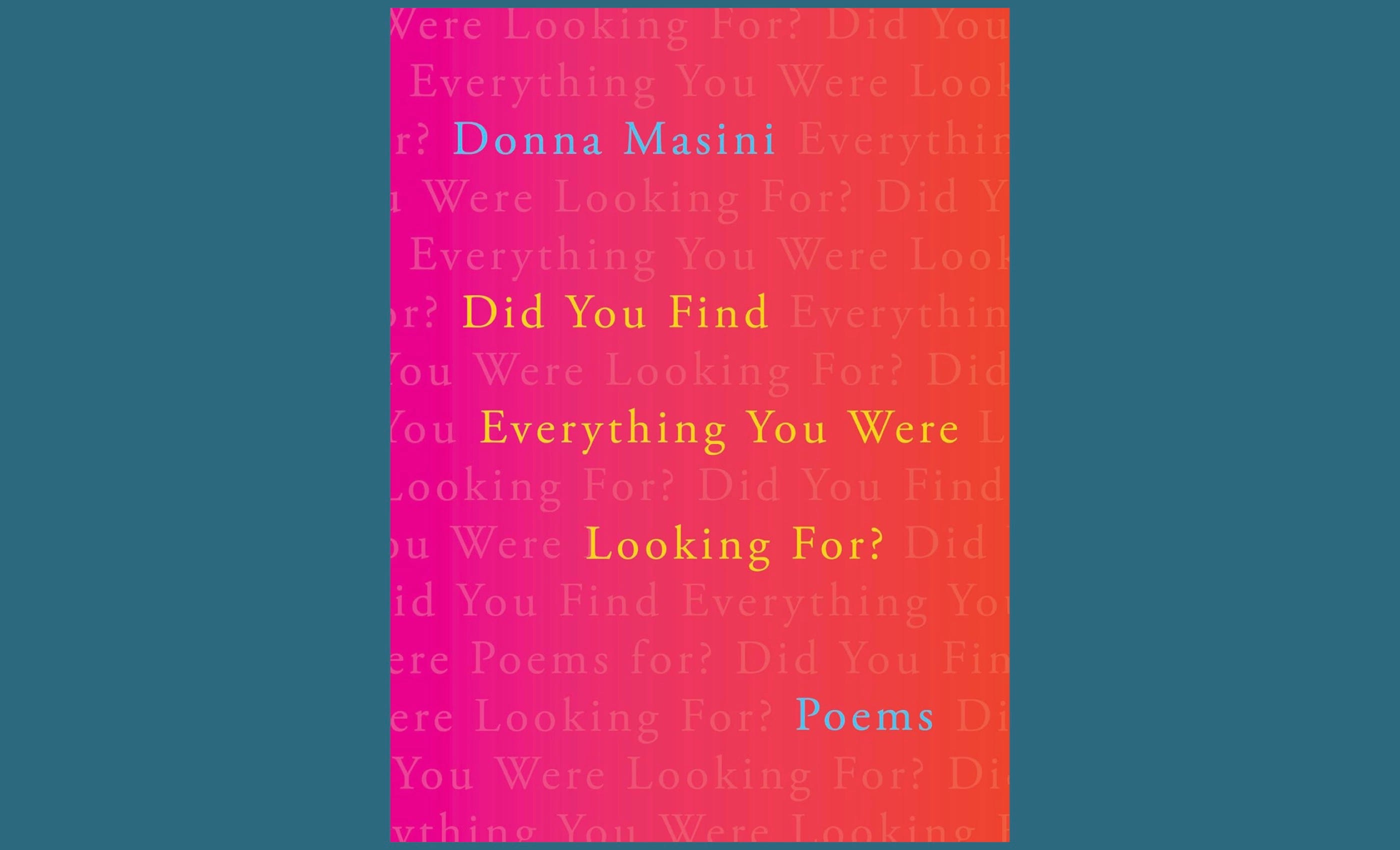
The sly wit in Donna Masini’s new collection starts right there in the title, Did You Find Everything You Were Looking For? She possesses an extraordinary gift for turning ordinary phrases and events in a light that illuminates their strange depth.
Beauty parlors, classrooms, a restaurant after hours — these are the everyday places Masini hangs out to explore “the democracy of grief.”
In one poem a woman “wonders / whether anyone uses the nylon sheath / that comes with a new umbrella,” and a moment later we look up to realize she’s talking about the “flimsy precarious parasol of thought” that keeps tragedy at bay.
Errands
I tried to ignore her, pleading old woman leaning on a tree guard
holding out a plate. I had no cash. It was hot. Late. So much to do.
Laundry, library, pharmacy, pet shop. I was lonely and limping,
my bags were tangled, and my friend had just died.
It was a sparrow — struggling, dust-brown, size-of-a-baby’s-hand
shudder of feather stuck to a glue trap.
Please, she said, help me. She was shielding the bird
the way you hold your hand around a lit candle. Never touch a bird,
I learned as a girl. I dropped the bags. I touched the bird,
the beating chest feathers, tried to peel the trap from its twiggy
leg, slowly, the way you ease a Band-Aid off. The bird — I barely saw it —
shot up, swooped up, up into the tree, onto the fire escape,
the pet store sign swinging above us, then — gone!
A residue of feather stuck to the trap. We saved her,
the woman said. She touched my arm. I’m almost blind, she said.
She must have heard the bird, felt for the sound under the parked car.
How long had she knelt there, waiting, between the tree guard
and parked car, how had she felt for it among the cigarette butts
and gutter trash? How had she heard it above the racket of traffic:
Honeycrisps and Pink Ladies had rolled out of my grocery bag
and lay, shining, on the late sidewalk. Days I’d been waiting for a sign —
which might be why I thought of Jon. How busy the dead must be
at the beginning of being dead. So much to do. Even after you die.
So much we need you to do.
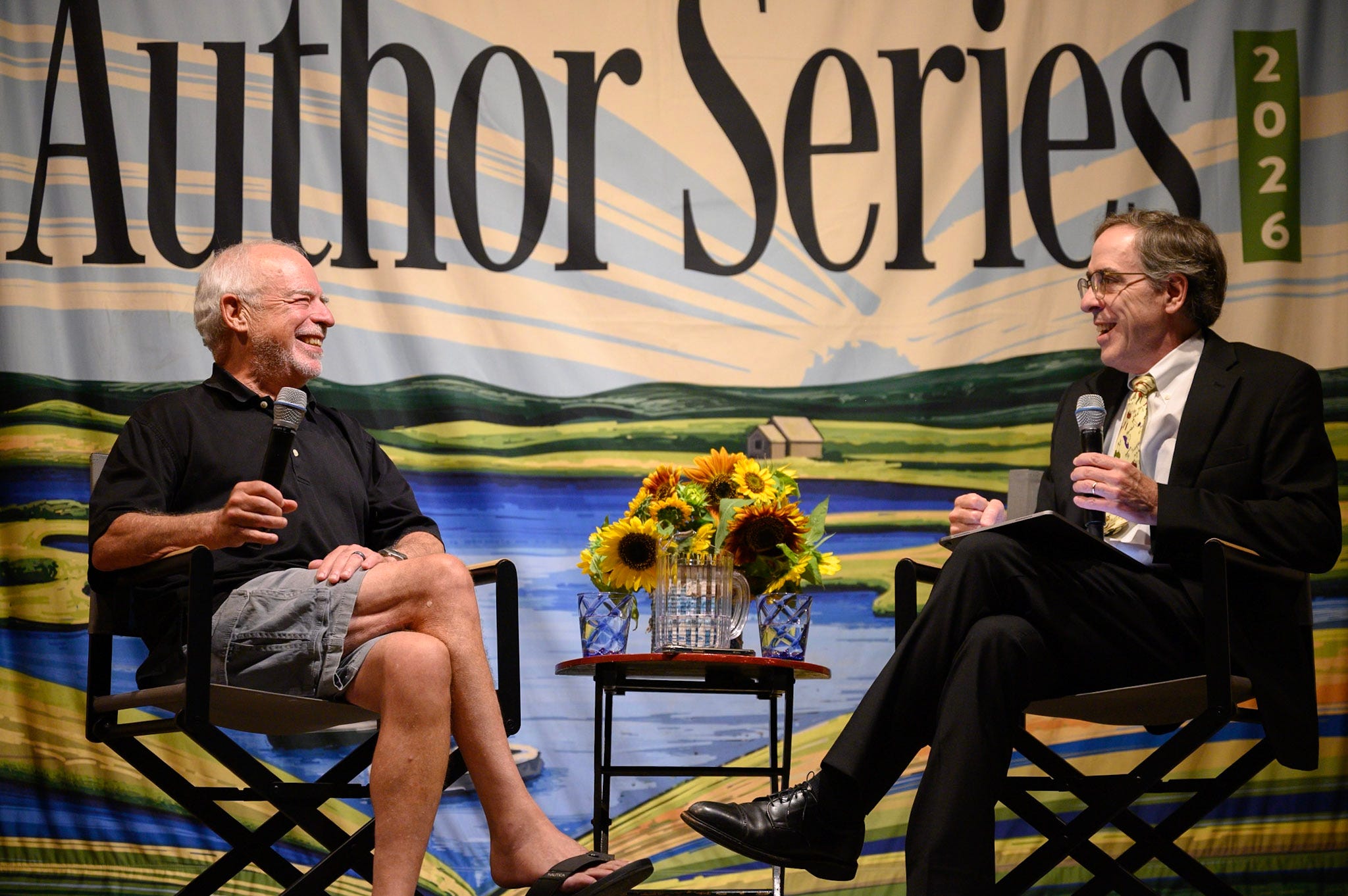
Richard Russo (left) dressed appropriately; Ron Charles (right) packed all the wrong clothes. (Photo by Jeanna Shepard)
The Writing Life
Last night on Martha’s Vineyard, I finally got to talk with the man who wrote the first novel I ever reviewed: Richard Russo.
Back in 1997, I was teaching English in St. Louis when a former student’s mother suggested I try writing book reviews. I bought a copy of Straight Man, wrote it up, and sold the review to The Christian Science Monitor.
The book literally changed my life. It was a great joy to tell him so in person.
Russo was on the island to talk about his career and his new novel, Under the Falls, as part of the Martha’s Vineyard Author Series. (Russo and I serve on the advisory board.)
The Series will close on Sunday with Michelle Obama in conversation with Michele Norris at 4:30. Because that event sold out in two minutes, a second appearance was added at 7:30. It, too, sold out.◆
Clippings
This week’s review is A Tender Age, Chang-rae Lee’s most autobiographical work of fiction, which burns away the sentimentality of childhood (review).
Speaking of, Christopher Robin was born on this day in 1920.
To salvage its inane seashell case against former FBI director James Comey, the Justice Department is now pointing to Comey’s 2025 thriller, FDR Drive, in which a right-wing podcaster encourages his followers to commit violence (details).◆
If you’d like to keep this book commentary alive, please consider a paid subscription. Even a few dollars helps.
In which Ron Charles, former book critic for the Washington Post, engages with an AI Reese Witherspoon via email to pursue getting his book review columns turned into an ensemble series, along the lines of White Lotus. 😂
On a warm evening in May, Lauren Sánchez Bezos walked the red carpet at New York’s legendary Met Gala wearing a sculpted, midnight-blue satin gown with a plunging neckline. The dress code for the party was “Fashion Is Art,” and Sánchez Bezos and her designer, Schiaparelli’s Daniel Roseberry, drew inspiration from the museum’s famous John Singer Sargent portrait “Madame X,” a 19th-century painting of an American socialite posing in a sultry black gown. The painting had at one point sparked scandal for the form-fitting sexiness and bejeweled straps of its dress, and Sánchez Bezos suggested Roseberry take it up a notch: “Let’s do a waist,” she told him. Roseberry complied — snugly binding her abdomen in a corseted style that visibly laced up her back.
The cinched waist looked familiar on Sánchez Bezos, harkening back to the many outfits she wore during her extravagant Venice nuptials in June 2025, including a tight-laced, corseted wedding gown that could have been pulled straight from the Victorian era in which the real Madame X resided. And she is hardly alone. “The tiny, tortured waist has returned as a bodily preoccupation,” The New York Times reported last fall, “ready to eclipse voluminous breasts and buttocks as areas of obsession, manipulation, distortion and angst.”
But the waist is not simply a matter of fashion. It is, increasingly, a statement of values. We’ve reverted “to a sense of what a woman should wear and look like that is restrictive,” historian Stephanie Coontz, who has studied the prevalence of the hourglass shape in modern culture, told me. The idea is that clothing should “show off your body and your fertility and your sexuality more than anything else about your personality.” For powerful women on the right, the uniform has become severe, as exemplified by the nipped-waist dresses worn by Kimberly Guilfoyle and Ivanka, Lara and Melania Trump.
This trend is, in fact, an old story. Fashion, like politics, is cyclical, and in periods of conservatism, the cinched waist tends to reign. It has previously been correlated not only with patriarchy and threats to women’s rights but also with rising authoritarianism. Since the start of the second Trump administration, there has been a lot of chatter about “Mar-a-Lago face” — the artificially enhanced lips, chins and cheeks common among MAGA women. But the implicit politics of a surgically distorted face is a recent development. Historically, if you want to know where politics is headed, a better guide has been the constriction of women’s waists.
***
Every era has its silhouette — that is, “the prevailing shape of any period and the way that clothes contour the body,” says Victoria Pass, a professor of fashion and design history at the Maryland Institute College of Art. Over the centuries, shetold me, different body parts have been amplified, and others diminished.
The invention of modern corsetry in the early 1600s allowed for the artificial shaping of women’s bodies. The corset was a garment of varying uses; before the invention of the brassiere, for instance, it served the valuable function of a bra. It also, however, became a powerful symbol of constraint: a way to restrict not just women’s bodies but also their ambition and autonomy.
Lauren Sánchez Bezos at the 2026 Met Gala.
Anthony Behar/Sipa USA via AP
In times of rebellion and revolution, therefore, women tended to eject the hourglass shape from their wardrobes. The women of the French Revolution traded the monarchy’s painfully heavy and structured gowns for simpler, chemise-styled empire waists. In 1800s America, suffragists drew a clear link between clothes and political liberty, arguing that unencumbered bodies allowed for unencumbered lives. Mary Walker, one of the country’s first female surgeons, heroically saved injured soldiers on the battlefields of the Civil War, only to dodge raw eggs lobbed at her in public when she ditched the requisite, and repressively tight-waisted, dresses of the day. She called corsets “torso prisons” owing to the enormous pressure they put on a woman’s internal organs, and she was routinely threatened with jail time for wearing pantsuits instead.
In political cartoons, suffragists who eschewed corsetry and traditional attire were widely mocked for being “manly” and abandoning their domestic duty. One cartoon depicted a perky blond in a pantsuit smoking a cigar and striding for the door on her way to vote while her bedraggled husband rocked a baby. As backlash to the suffrage movement grew at the turn of the last century, new municipal codes and state laws made it illegal to appear in public wearing clothes not matching your assigned birth gender. Women faced arrest, or the risk of being sent to a psychiatric institution, for not following conservative dress codes. At the same time, the corset became part of a new “S” curve meant to exaggerate a woman’s bosom, thin her waist and push out her backside.
By 1920, white women had earned the right to vote, and flappers jettisoned their mother’s corsets for short, tubular dresses. The flapper style erased visible class distinctions: Women of different races wore it, as did the wealthy and those who worked for a living; suddenly, you couldn’t easily identify class differences based on apparel. It also led to a moral panic: If a woman could dress that easily and with so few layers of undergarments, she could certainly undress just as quickly. Women’s fashion was soon being blamed for divorce, and, Fortune magazine reported in 1930, “many speculative persons believe that a return to dignity and formalism in attire presages an accompanying return to statelier morals and manners.”
As conventional dressmaking once more dictated that women force themselves into structured clothes, a young American fashion designer named Claire McCardell (who I wrote about in a new biography) refused to go backwards. She argued that a woman’s clothes should enable her ambitions, and that women should have the freedom to work and to participate in public and political life. She cut her garments to fit a woman’s natural body. Corsets “push you out of any resemblance to the way nature made you,” she said. The purpose of clothes should be to support a person’s lived experience. “I don’t hate crinolines as such,” she once joked about the material that enhances a woman’s skirt. “I hate them when they try to get in elevators.”
McCardell, along with a group of mostly women designers in New York, led a fashion revolution by inventing the American Look, sportswear that prioritized comfort and movement in women’s clothes. McCardell revived and updated the classic, simple wrap dress. She popularized leggings and put pockets in all her clothes; she also invented ballet flats and mix-and-match separates, which became staples of modern fashion. Comfort, she said, was the keynote of style, and she placed closures in easy reach of the wearer, so that a woman could dress herself without needing help closing a back zipper. “In the days of dependent women — fainting women, delicate flowers, laced to breathless beauty — a girl couldn’t cross the street without help,” McCardell wrote. “Her mission in life was to look beautiful and seductive while the men took care of the world’s problems. Today women can share the problems (and possibly help with them) partly because of their newfound freedom from clothes.”
Meanwhile in Europe, fashion was becoming a powerful tool for shaping cultural conformity under fascism. Propaganda in Germany and Italy showed women wearing shapely peasant attire surrounded by cherubic children. The traditional dirndl, a dress with a cinched waist perhaps best known as classic Oktoberfest attire, became pervasive during the reign of Hitler and closely tied to his supremacist notions of Germanic “purity.” Young women in the anti-Nazi group the Edelweiss Pirates refused to wear the prescribed clothes as part of a broader rebellion against the regime, risking their lives in the process.
American women went to work in droves during World War II, dressed in the practical and freeing garments created by designers like McCardell, only to be ordered back to the kitchen when the men returned. In 1947, Christian Dior reintroduced a severe hourglass silhouette in his first-ever collection. The French fashion designer said he wanted to “save women from nature,” comparing their idealized shape to the number eight: wide at the ample bosom, extremely thin at the waist, and wide again at the swelling hips. He famously took a hammer to a standardized wooden mannequin to whittle the waist to his preferred size of 18 inches, which was about 11 inches smaller than the average waist in the 1940s. To achieve his hourglass, women wore shoulder and hip pads, padded bras and tight-laced corsets. The collection became known as the New Look, even though it represented a reversion to Victorian era restriction.
In a 1955 article, headlined “The Gal Who Defied Dior,” McCardell told a young journalist named Betty Friedan, “You can’t go back. You have to design for the lives American women lead today.” Like McCardell, American women initially protested Dior’s extremism — as did men, including one Idaho husband who complained to Dior: “You have disfigured my wife with your genius.” But eventually the New Look’s hourglass became the aesthetic of the 1950s housewife. Then, the pendulum swung back again in the 1960s and ’70s. All American women finally gained access to the polls thanks to the Voting Rights Act of 1965, while second-wave feminism led women to shed the thin-waisted dresses and aprons of their mothers.
Still, the severely nipped waist of the hourglass has never permanently gone away. For centuries, women have tried to kill it — and failed. Last summer, Dior revived its New Look silhouette and put it on pop star Sabrina Carpenter.
***
Today, with Trump in the White House and authoritarian ideas experiencing a revival, the hourglass silhouette has again become shorthand for traditionalism. In 2024, the anti-feminist women’s magazine Evie released a “raw milkmaid” dress, modeled after the dirndls worn by “hardworking dairymaids” of Europe, as the ad copy extolled. It featured a severely scooped neckline and a structured bodice with corset boning “that cinches the waist beautifully.” The hourglass silhouette can be seen both in Washington’s halls of power and among the cultural figures shaping the next generation of conservative women. Influencer Savanna Faith Stone, a speaker at this summer’s Turning Point USA Women’s Leadership Summit, can be found baking on her social media feed in an hourglass dress with cut-out waist details. She also contends that women should stay home, defer their political vote to their husband and “dress however your husband likes.” (Never mind that the women delivering such traditionalist messages, like 1970s conservative activist Phyllis Schlafly before them, often lead public lives and make money outside the parameters of the gendered domesticity they decree for everyone else.)
First Lady Melania Trump at the New York Stock Exchange earlier this year.
Anthony Behar/Sipa USA via AP
The increased emphasis on the “strong hourglass,” Sara Jablon-Roberts, an associate professor of fashion merchandising at Sam Houston State University, told me, “harkens back to the ’50s, which itself harkened back to the Victorian age.” But the latest incarnation features modern twists, where medical technology has dramatically extended the possibilities afforded by diet, exercise and shapewear. Last fall, New York Times reporter Linda Wells described a new, painful procedure in which a woman’s lower two ribs are fractured and trimmed down to achieve an indented midsection. After the surgery, a woman must don a corset full-time for months to help reshape her body.
One argument for the endurance of the hourglass is that men find it inherently preferable. This evolutionary reasoning, Coontz writes in her latest book, is a myth. When researchers showed images of women with classic hourglass measurements to isolated hunter-gatherer societies, the men deemed the women not only unattractive, but unhealthy. “One speculated,” Coontz writes, “that the poor thing was suffering from severe diarrhea!”
In truth, far from being an evolutionary imperative, the hourglass has, historically, been the shape of wealth and class and whiteness. Few can afford the luxury of dressing or refashioning their bodies this way, let alone the family structure where only one spouse earns wages for their labor and domestic work is uncompensated.
Even some conservatives are growing alarmed over right-wing fashion. Megyn Kelly short-circuited on her podcast after Sánchez Bezos wore a bustier to Trump’s inauguration, saying she looked pornographic. Marjorie Taylor Greene, an outspoken advocate for the release of the Epstein files, last year criticized what she called “MAGA Mar-a-Lago sexualization”: the many women clambering to dress themselves to the president’s rapacious predilections. “I have two daughters,” Greene told the Times, “and I’ve always been uncomfortable with how those women puff up their lips and enlarge their breasts.”
***
In July, the fashion house Schiaparelli — the one that designed Sánchez Bezos’s Met Gala gown — held its fall couture show in Paris. Models walked the runway in dresses featuring corseted tops made of form-fitting silicone sculpted to resemble a naked body replete with breasts, a belly button and an ultrathin waist. The backs were laced with ribbons, evoking a traditional corset. Roseberry, the creative director, named the collection “The Call of the Void,” equating the act of making these clothes to the feeling of driving off a cliff and into an abyss. The collection, he said, was part of the fashion house’s long history of pushing boundaries in shape and material. But the sight of so many breast-plated models, coupled with his cliff imagery, instead called to mind the fateful last scene in “Thelma and Louise”: Women have been pushed to the edge.
Elsa Schiaparelli, who founded the eponymous couture house, was a dissident against the conformity of 1930s Fascist Italy — a designer who harnessed humor and extremity in defiance of the status quo. “In difficult times, fashion is always outrageous,” she once said. Now, we’ve merely captured the outrageousness of the oppressive.
WhenSánchez Bezos wore her custom Schiaparelli to the Met Gala, fashion critics dismissed it as derivative and dull. And they were right. More, the return to the cinched waist reflects a nascent authoritarianism that seeks to suffocate the diversity of democratic culture in its tight-laced grip. And yet, there is hope. “We’ve done this before,” Coontz told me. “That’s what they did after World War II, and [women] didn’t like it.” In fact, they started a revolt in fashion and in politics. One that fueled a wave of activism, earned women legal and financial rights — and advanced the hard, necessary, ever-incomplete work of ushering in a better country for all of us.
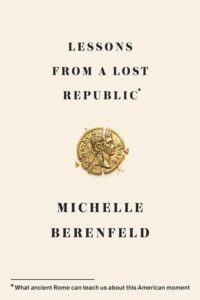
Now that our president is minting gold coins with his face on them, building a triumphal arch, and sponsoring blood sport in the capital, it seems like a good time to read up on ancient Rome. That’s what I was thinking when I wrote Lessons from a Lost Republic: What Ancient Rome Can Teach Us About This American Moment. It explains how the ancient Roman Republic collapsed into autocracy and how we might prevent it from happening to us. For those who might want to learn more about the messy world of ancient Rome, I recommend starting with historical fiction and an ancient Roman epic. While others are busy poring over Marcus Aurelius’s late-life musings about how to be a better Roman emperor (hint: slaughter “barbarians,” persecute Christians, choose your idiot son as your successor), you can enjoy these books instead.
This 1972 novel about the rise of Augustus—the man we call the first Roman emperor—is told almost entirely by those who surrounded and enabled him. The transition from republic to autocracy is narrated through (imagined) letters and journals of his closest advisors, friends, and family. Even for those of us who know what happened, the author creates an intimate view of this extraordinary period through the inner thoughts and conflicts of the aspiring emperor’s closest confidantes (imagine a novel about Donald Trump told entirely through Pete Hegseth’s Signal chat and Melania’s diaries, but beautifully written). Augustus is at its most compelling when we hear from his exiled daughter, Julia, who does not get her say in the historical sources, but whose tragic fate is sympathetically drawn in this novel.
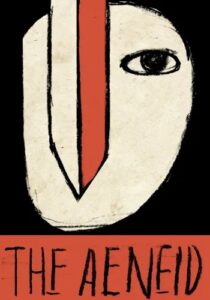
There is perhaps no greater Roman writer than Virgil (apologies to another recommended author, Ovid, below) and no greater Roman poem than the Aeneid. It is an epic in the mold of the Iliad and the Odyssey, but written centuries later by a poet working under the watchful eye of a still-figuring-it-out Roman emperor. In the Aeneid, Virgil crafts the story of Rome’s distant past in a way that “predicts” the best possible version of the world he was actually living in. Even if he did not necessarily believe it all, Virgil shaped the story of Rome and Augustus into a masterpiece. If you think you don’t know the Aeneid, imagine the story of the Trojan Horse and thank Virgil. I don’t think he is credited in Christopher Nolan’s Odyssey, but he probably should be.
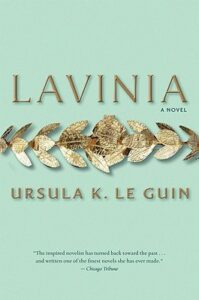
If you find yourself missing Virgil after the Aeneid, you can turn to this lesser known, but brilliant novel by Ursula K. Le Guin. It is an early contribution to what is now a cottage industry of stories told from women’s points of view in classical mythology. Lavinia was the young woman whose hand in marriage was promised to Aeneas, the hero of Virgil’s Aeneid and founder of the Roman people. Her role in the origin story of Rome is crucial but unvoiced. Le Guin not only gives Lavinia something to say but also conjures her whole life and her world as they could have been or should have been. A brief but essential bit of science fiction provides the marvelous, impossible conceit that gives Lavinia agency she never had even as she remains a character written by a man in the future. She knows what is to come but makes her choices and lives her life in a magnificently described world. Le Guin’s version of pre-Roman Italy is the version I now imagine whenever I read the Aeneid.
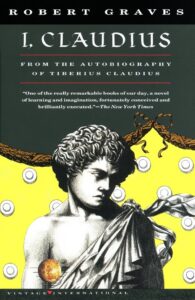
A saga of the first dynasty of Roman emperors in all of their back-biting and conniving glory, this 1930s novel inspired a soapy 1970s mini-series that set Derek Jacobi up for a lifetime of wearing togas on the silver screen (I once asked AI to generate a picture of a bust of a Roman senator and it made one with his face). Extrapolating from salacious and rumor-filled ancient sources, the novel offers an inside scoop into the machinations of the first Roman imperial family. It paints a picture of Livia, the wife of Augustus, as someone not to be trifled with, unless you like your figs with a dash of poison. A huge bestseller over the decades, it remains in print. Graves wrote another novel about a different famous family of the first century CE—it’s called King Jesus (good, but not as good as I, Claudius, imho).
No one is sure what the Roman poet Ovid did to tick off Augustus, but whatever it was, it got him exiled to a seaside town in Romania for the rest of his life. Although a nice enough place, it wasn’t Rome, and Ovid never stopped complaining about it or trying to get the emperor to let him come home. The Tristia is a series of poems describing his exile and making a case for forgiveness. It even includes a poem that addresses the book itself, telling it how to present itself when it gets to Rome. Ovid’s Tristia is less famous than his magnum opus, the Metamorphoses, but if you want to know what it is like to be a once-famous artist who gets on the wrong side of an autocrat, this is for you.
As a person who lives on a peninsula between two rivers used for shipping, this is surprising to me. I assumed water traffic was lower emissions for some reason.
 Log in