scriptrix. hedge scholar. autistocrat
72 stories
·
0 followers

At Festival America, France’s America-Themed Literary Festival

1 Share
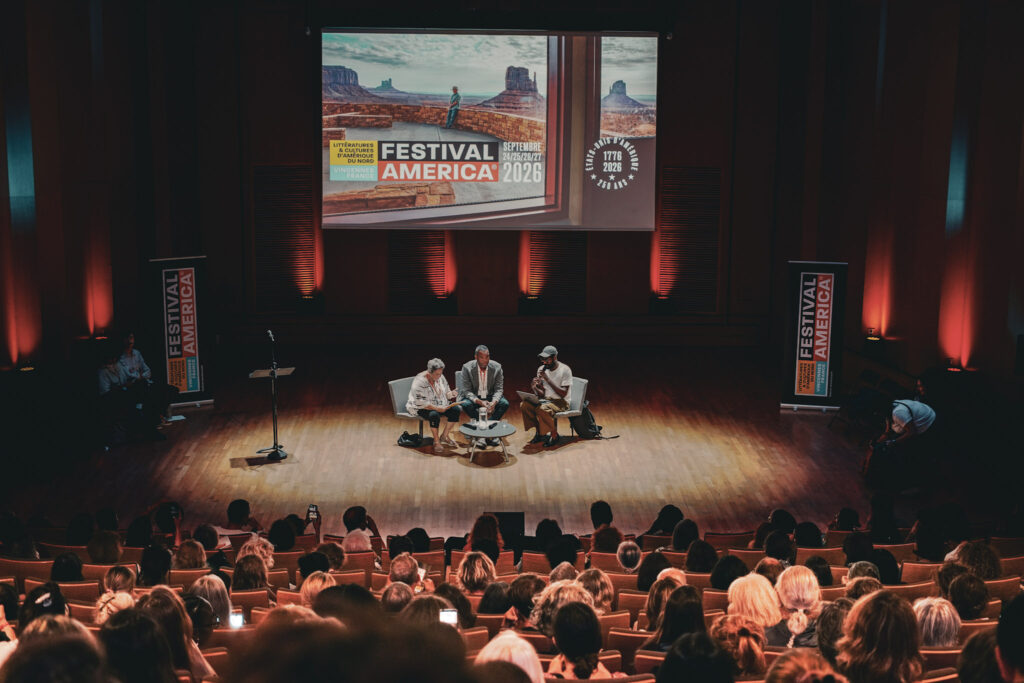
Ta Nehisi Coates panel at the Festival America

Ta-Nehisi Coates panel. © Siriot de la Petra.

This summer, Festival America, a four-day event that is not in America, released its trailer—a supercut of iconic imagery spanning the history of the United States. Native American men riding horses. A portrait of George Washington. The site of the 1890 Wounded Knee Massacre. Men digging a mass grave. Suffragists parading. Troops storming Normandy. A mushroom cloud. A rocket launch. And text: 

Littérature.

Expositions. 

60 autrices et auteurs américains.

Next came the headshots of John Grisham and Joyce Carol Oates, Laura Kasischke and Ta-Nehisi Coates, superimposed over scenes from the March on Washington. Next, a ticker tape of sixty names, one of them my husband’s, scrolled across footage of men marching into war. The mostly black-and-white montage switched into color as Ronald Reagan signed a bill and a plane smashed into the Twin Towers. 

Festival America, which is held every two years, typically invites authors from across the United States, Canada, Mexico, and the Caribbean whose works have recently been translated into French for a series of panels and workshops in Vincennes, a town just outside Paris. But the 2026 lineup was 100 percent from the U.S.A. in honor of the country’s semiquincentennial. Among those invited were Alison Bechdel, Tommy Orange, Viet Thanh Nguyen, Karen Russell, Patrick Radden Keefe, and many more of our nation’s best-known working writers, plus my husband, Jake, who was suffering from an acute case of impostor syndrome. 

To say Jake was surprised to be included in this lineup is an understatement. His debut novel, Slime Line, was published so quietly by a university press that when he signed with a larger imprint in New York for his next book, his editor still referred to him as a “debut author.” Nevertheless, a major French publisher acquired Slime Line—or as it’s known in French, Alaska Parano—and two years after its U.S. release, we flew from Pennsylvania to Paris to find that he’d amassed a not-insubstantial Francophone following. His book was front and center on the NEW AND NOTABLE table at the bookstore near our hotel. It was there, too, at a bookstore on the next block. And guess who was a STAFF PICK at Shakespeare and Company.

Jake was beside himself with a confused sort of glee. The fawning messages he’d received from French-language accounts on Instagram were beginning to make sense. One post praised his novel—which is based on his experience working in the commercial-fishing industry—for being a beautiful treatise on the “solidarity of magnificent losers.” 

Around this time his French publicist reached out. She wanted to know if he would speak to a journalist at a major French magazine for a profile as the “new voice of America.” Evidence was mounting that Jake’s work was touching a very specific French sensibility. In Vincennes, I made it my mission to find out what. 

*

That’s not exactly true. That’s just something journalists say to end their opener with a little narrative thrust. Getting to the bottom of French literary sensibilities was more of a secondary reason for me, trailing wine and cheese. On the festival’s first full day, authors and their plus-ones were invited to a “cocktail lunch” at the Château de Vincennes, the seat of French kings from the fourteenth through the seventeenth centuries. There, we chewed on skewered radish slices, thin breads topped with charcuterie, and pert meringues in the shadow of the tallest donjon in Europe. 

Château de Vincennes, CC BY-SA 4.0, via Wikimedia Commons.

Over drinks, I asked the festival’s head interpreter if there was any historical torture equipment around. She told me that the most terrible death at the château had less to do with torture than with disease. During the Hundred Years’ War, King Henry V of England had retreated there shortly after the Siege of Meaux. He’d just conquered Normandy and was near to becoming king of France. But the man barely had time to settle into his new digs before he got dysentery and died. That was in 1422. 

Observing the United States’s birthday in Europe is a reminder that we have a minuscule history—a cultural handicap that our literature must overcome. “Compared to Europe,” the festival’s founder, Francis Geffard, told me, “it’s very recent.” Nevertheless, two hundred fifty is a pleasingly round number, and he saw “a good occasion” to make this year’s festival about the U.S. It also allowed him to pursue what might seem like a lofty goal: to assemble enough American authors, spanning generations, geographies, and identities, to see once and for all “what American fiction has to say to readers outside of America.” 

This seems like an impossible task until you remember the one thing that unites American writers, old and young, established and emerging: they will nearly always accept a free trip to Paris. As Francis told me, “It is very unusual for a writer to turn down the invitation.” 

*

After cocktail lunch, Francis was moderating “The French Taste for American Literature,” a roundtable with three Francophone experts on American letters, at the Hôtel de Ville, Vincennes’s nineteenth-century town hall. To enter the building, I had first to walk along a red carpet, flanked by a photography exhibition featuring, among others, an image of terrified migrants paddling across the Rio Grande. Inside, more than two hundred people had climbed the grand staircase to the marriage hall, where frescoed aristocrats looked down from the walls. The previous festival had drawn sixty thousand people—the press team didn’t seem to think this year’s turnout would be any less.
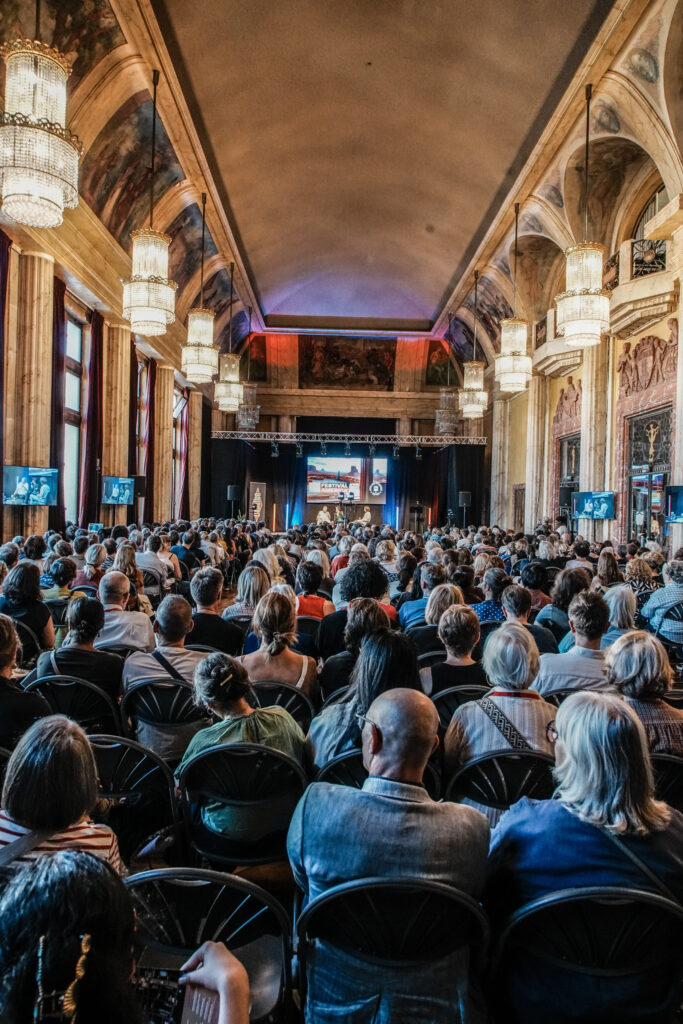
This was a French-language panel, and Francis’s questions hinted at certain shared assumptions among French readers. “We agree that American writers aren’t quite the same as, say, French writers,” began one. “From France, we often tend to imagine the United States as a country without culture,” began another. 

One of the panelists was Sébastien Bonifay, a Corsican writer and bookseller who traveled to the U.S. more than twenty times to visit his favorite American authors at their homes, often for days at a time. His recent book, (Not) Born in the USA, recounts meetings with James Ellroy, Chris Offutt, Donald Ray Pollock, Stuart Dybek, James McBride, and more. These are known names, if not exactly those an American would pick. “The literature that nourishes me,” he said, “is an American literature that Americans don’t like.”

He called it “a literature of the margins,” and panelists riffed on what those rough edges were. One placed marginal American literature in a lineage of countercultures that rail against l’establishment (anglicism, pejorative)—rock and roll, psychedelia, punk. Another said that the United States has two literatures: one of “the coasts” and one of “the other,” rarely published but often excellent. This thrilling literature of the margins was often published by universities, which, the panelist said, “have wonderful presses.” It didn’t matter that this type of book didn’t always achieve mainstream acclaim; the panelists seemed to trust their own taste. 

The more the panelists riffed, the more they came to describe my husband. A panelist brought up the idea of “an American-style résumé”—belonging, it seemed, to someone who fits writing in between blue-collar gigs. The panelists called this type of writer “artisanal,” someone “whose real-life experience shows through in their work.” This writer “had lived.” And this writer had done so in places the French reader could hardly imagine, like Ohio.

It’s in this misunderstood land that Sébastien begins his book: in a Wendy’s parking lot, sweating with anxiety about his impending visit to Donald Ray Pollock’s house. After the panel, I found Sébastien sitting behind a stack of copies in the book-signing tent, and he told me he fell in love with American literature at fourteen, reading Stephen King. It wasn’t the horror that gripped him; it was the way King described small American towns. Before a single plot twist even dropped, Sébastien was entranced by Derry, King’s fictional Maine hamlet. This pleased me, as someone from an American town. 

“The writers who have a lot of success in France,” he said, often aren’t as successful at home, and sometimes “are not even published in America.” I asked him why French people liked American literature that doesn’t get much attention in the U.S. He had a theory about this. “French people, they’ve got a problem with America,” he said. “We are fascinated by America. But we truly, deeply think we should be, as France, as a country, where America is.” 

For one, France has so much more history, whereas the history of the United States is terribly short. That’s why many of the American books that become popular in France show America’s darker, shittier, seedier side. He pointed to Benjamin Whitmer, an American writer whose noirs have a much larger audience in France. Sébastien visited Whitmer in Colorado as part of his series of pilgrimages to the United States. 

“This guy has got thirteen guns,” Sébastien told me. French people think owning a gun means you’re a redneck, he said. But when Sébastien visited him in Colorado, Whitmer asked him about Maurice Blanchot. “Maurice Blanchot!” The fact that someone could own thirteen guns and be a fan of the French literary theorist Maurice Blanchot was significant enough to warrant repetition. “Benjamin Whitmer knows Maurice Blanchot,” he said. “He reads Maurice Blanchot, and he’s got thirteen guns.” He moved his fist emphatically, then clarified. “One of them is for the grizzlies. One of them is for the coyotes.” 

To Sébastien, Whitmer was one kind of writer, to be juxtaposed against another. “It’s just my opinion, but these writers are a lot better than the other ones,” he said. “Really, I don’t care about Jeffrey Eugenides! Really, I don’t care.”

*
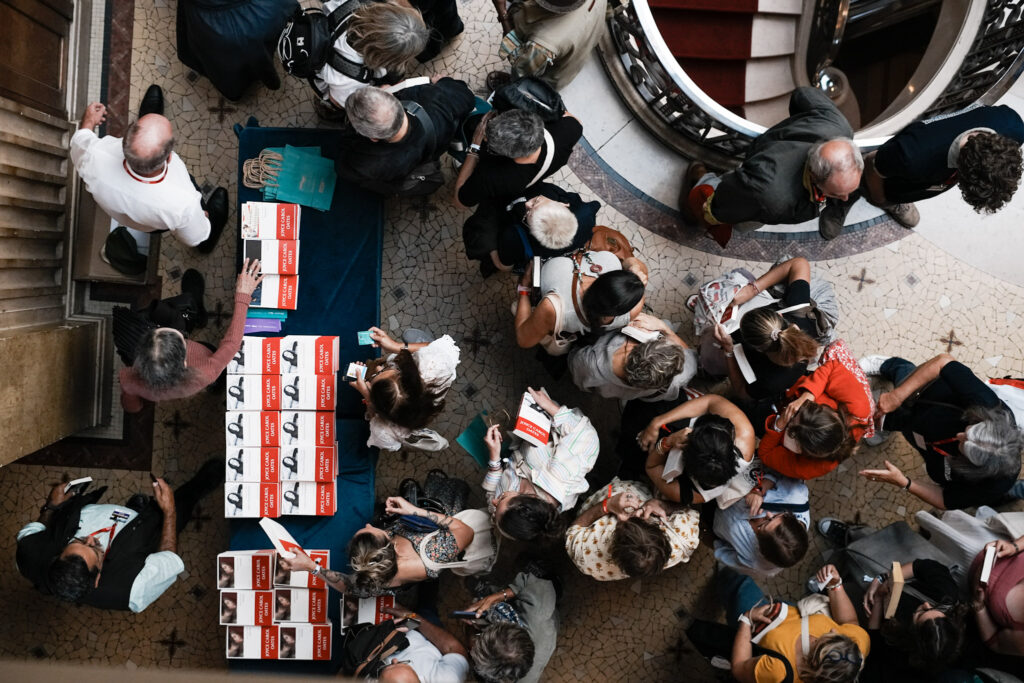
© Siriot de la Petra.

Elsewhere in the bookselling tent, Jake, the proud author of a title published by West Virginia University Press, was already flying through book sales. He had just spoken to a class of teens who had mobbed him like a rock star.  When I told him about Sébastien, he said, “That guy rules. I think he wants us to come to Corsica.”

A long queue for Joyce Maynard snaked around the booths. I introduced myself to two women thumbing through books, asking them what they liked about American literature. “The stories, the journey, the wide-open spaces, and all that,” said the younger one, who quickly turned her own questions on me. They had come here to learn about America, and here I was, a real, live American. At their prodding, I told them about my husband’s work.

“Ah, that wouldn’t exist here, someone who writes about being a fisherman,” the woman said. “In France, it’s more l’establishment.”

I asked what she meant by l’establishment. 

“Professionals,” her companion clarified. “I thought your husband would be more like a banker, to be writing about capitalism.” 

To understand French literature today, the younger went on, I ought to consider the woman in the black hat with the red lipstick. “She has her own myth,” the older woman said. 

I’ll confess that at this point, I assumed my French was failing me. The older woman had just made a point about le wokisme that I couldn’t quite follow and, out of fear, didn’t ask her to clarify. But I looked up the lady with the black hat and red lipstick later, and it turns out they were speaking about Amélie Nothomb, a Belgian-Francophone novelist with a penchant for wearing large hats and appearing on TV. She was named a baroness by King Philippe. 

There seemed to be all sorts of fashionable characters floating around the French literary world. The novelist Rob Franklin told me he was at the festival’s opening ceremony when an older woman named Sophie introduced herself to him. She was around ninety and striking, with a pixie cut and an eccentric style. Rob had been told that his French editor was named Sophie. This woman asked if she could take his picture. “I was like, ‘Okay, sure. My publisher wants to take my photo,’ ” he told me. Sophie pulled out a monocle to look at her schedule. Then she did a portrait session with him. 

The next day, Rob went to meet Sophie at his publisher’s tent. It was a different woman. He spent the festival wondering who the hell had taken his photo until the last day, when Sophie No. 1 found him again and handed him her business card. It turned out she was France’s most famous photographer of writers, and she’d been doing it for sixty years. “I found out she’s like … quite famous,” he told me. On her card was a black-and-white portrait she’d taken of Michel Foucault. 

*

There was one person I wanted to ask about the word l’establishment: Fabienne Gondrand, a literary translator who served as Jake’s interpreter throughout the festival. Fabienne had sat beside him on panels, repeating his comments in French. I told Fabienne that a few people had used this word with me to pinpoint the differences between French and American contemporary literature. I wondered if she, too, thought American writers were more anti-l’establishment. 

“That’s a little reductive,” she said, seeming surprised. She thought perhaps the people I’d spoken to had used that word because the festival had done a good job curating diverse voices, such as nonwhite and Indigenous writers whose works explicitly challenge American cultural norms. It occurred to me that I had perhaps oversimplified what French readers had intended l’establishment to mean. I’d developed a self-serving theory that the writing world consisted of two camps (coastal literati and scrappy Rust Belt writers with jobs) and that in France, everyone recognized the latter as superior. This is silly, when l’establishment is so obviously not writers in major metro areas with big book deals. L’establishment américain, really, had been invited and declined. I’m talking about Charles Kushner. 

At every edition of Festival America since 2002, Francis told me, the U.S. ambassador to France has given a speech on opening night. Currently, that position is held by Kushner, the real-estate developer and pardoned felon. The U.S. Embassy typically forks over a little cultural funding for the festival—less than the Canadian embassy, but not nothing—and this year they slashed their contribution by 80 percent. Francis took this as a sign of distrust and refused the embassy’s money altogether. 

Francis told me that French people “are feeling a little estranged” from the U.S. at the moment. Shortly after we spoke, Festival America distributed a press release with sharper wording. “Ironically,” it said, this funding cut had occurred during “the very year of the 250th anniversary of the Declaration of Independence,” when the festival was hosting the largest delegation of American writers ever “in our country, and likely in Europe or anywhere else.”

The festival is right to point out the rarity of this delegation, as these writers would rarely be grouped together. On home turf, they’d more likely be gathered by subject matter, identity, or genre, because in the U.S., “American” is not a uniting descriptor—we’re too close to see clearly. But in Vincennes, we can step back and see the whole picture. What struck me about French readers was their confidence in their own taste, in how it could supersede that of most American readers. But French people have been gazing upon America their whole lives. When I returned from the festival, I found myself in a rare moment of America gazing back. Kushner’s embassy was advising Americans to “exercise caution.” Since the festival, student protests there have erupted into widespread riots, and I think we could safely say those were aimed at l’establishment. 


Noelle Mateer is a journalist in Pennsylvania. Her work appears in the Guardian, The Baffler, Wired, and more. 
Read the whole story
KristenHG
8 hours ago
reply
Share this story
Delete

Former New York Times Romance Columnist Olivia Waite on Her Firing

1 Comment

On Oct. 30, novelist and New York Times romance columnist Olivia Waite logged onto BlueSky and saw a post by independent journalist Marisa Kabas. She read it, hit repost on a comment, and went about the rest of her day.

Later that evening, Waite received an email with a blank subject line. Her editor at the Times, Tina Jordan, wrote that the paper would not be continuing her freelance contract as the New York Times Book Review’s romance columnist.

The post Waite shared included an email exchange with New York Times editor Patrick Healy, where Kabas questioned the paper’s Oct. 26 article covering a new report released by Democrats on the House Judiciary Committee. The report called for an independent special counsel to investigate President Donald Trump’s ties to convicted sex offender Jeffrey Epstein, and it included new details of rape allegations against President Trump by Beatrice Keul.

Kabas pointed out that the Times article made no mention of these new details and omitted use of the word “rape” entirely. Waite’s reposted a comment that called Healy’s response “unacceptable.”

“On Friday the Times declined to continue my contract as a fiction columnist, via a one-paragraph email praising the quality of my work but citing my presumably negative feelings about the NYT as inferred from my Bluesky posts, which they admitted they have been monitoring,” Waite wrote in a statement to Smart Bitches Trashy Books, who first reported the news of Waite’s columnist status on Nov. 3.

“I’m not interested in being a main character or going viral. I just wanted the romance people to know that this had happened,” Waite said in a video call this week.

Waite’s contract with the Times links to the paper’s guidelines on ethical journalism for “outside experts,” she said. In six years of writing the column, she said there have never been any issues with financial disclosures or conflicts of interest.

“I have never, to my knowledge, articulated my own critique against the Times on social media. That felt like a bridge too far, to me,” she said. “But pointing out that other people had valid critiques felt like—where else are they going to hear it?”

Waite shared her thoughts on the freelance nature of her contract, the romance genre’s relationship to issues of consent and rape, and where the state of romance books coverage stands now. This conversation has been edited for length and clarity.

*

Zachary Fletcher: You mentioned working on your “Best Romance of 2026” column for The New York Times. Tell me about your column and that piece in particular. Are there still plans for it to run?

Olivia Waite: I feel like the authors deserve it. It’s not about me. This column has always been a relief for me because, as a writer, you spend so much time with your own work and then you have to go out and talk more about your own work to promote it. And it starts to feel really boring. I can love my books as much as I want, but I want to talk about something else at some point. And the column was about other people’s stuff. It was a chance to talk about what people are trying and to present it to an audience that might not have the reach to see where some of these debuts or marginalized voices were coming from.

I really like showing the breadth of what romance is capable of, rather than showing the five books you already know about. The “Best Of” list was a really important part of that. And there’s something really pleasing about going out on a best-of list—which is something that only happened because I insisted on it. That was something I deliberately did. It was not initially part of the gig. And now it’s part of the institution, and I feel like that’s a very small kind of legacy.

When I see someone in power who’s been accused of sexual assault—specifically coming from a government investigation that’s recommending a special prosecutor—I think that’s germane to what I tend to talk about and what I write about.

ZF: We’re now a few days out from your repost and when you received word of the contract termination. This also happened just before the 2026 elections. How are you thinking about the timing of these new Trump rape allegations and this current moment as a romance reader and writer?

OW: Sexual assault and rape, both in society and in history, is something I consider part of the romance beat. Because romance history itself is so tied up with questions of sexual assault. You go back to the early bodice rippers, and the one that people kind of cite as the first modern romance novel is The Flame and the Flower [by Kathleen E. Woodiwiss]. It famously opens with the hero raping the heroine. They used to call it forced seduction or dubious consent or a whole realm of terms for fictional instances of rape in a specific romance context.

And nowadays, with things like romantasy and dark romance and serial killer romance and stalker romance, the whole thing—plus backlash to the MeToo movement—you have this incredible genre-wide conversation on how do you negotiate consent between people whose social power is uneven? How does desire change that? Does it? Does desire excuse things? And again, this has been a genre-wide theme for longer than I’ve been alive, much less a working critic. And so when I see someone in power who’s been accused of sexual assault—specifically coming from a government investigation that’s recommending a special prosecutor—I think that’s germane to what I tend to talk about and what I write about. And so it did not occur to me that this would be a problem.

ZF: In your statement, you write about the distinction between feelings and critique when it comes to issues of rape. How do you think about the difference between what’s happening in a novel and in the real world?

OW: There’s a lot of very complicated conversations about rape in romance. In terms of literary theory, there are essays saying rape is different in romance than in real life. And you hear readers say over and over again: I enjoy reading rape fantasy, but I don’t want it to happen in real life, those are different things to me. A lot of survivors cope with the emotional fallout by reading very violent scenes of sexual assault. You see this in fanfic all the time. But it’s very delicate. How do you make a romance around somebody who’s had such a violating experience? And it’s this very delicate, nuanced thing, and there are a lot of people, myself included, who find the kind of stories where people are careful about consent much more soothing and escapist. So you have to, in these discussions, allow room for opinions that differ very widely from yours that are equally passionate.

And all that goes completely out the window when you’re discussing an actual real-life crime.

We do not have to allow for “well, maybe there was a reason this person raped.” That’s how you get the Cornell stuff happening. It’s one of the pillars of rape culture, the idea that, for a man to pursue sex is healthy and normal, even if he has to use violence or manipulation to get it. And so you can’t have the same level of detachment that you can when you’re discussing somebody who really enjoys non-consensual fantasies in fiction and finds them very empowering and soothing. Romance probably talks about rape more than any other genre out there. Especially and specifically from the perspective of the victim.

ZF:  The number of full-time working book critics is shrinking, and freelancers make up the majority of the market. Can you talk a little bit more about what it means for the Times to potentially lose this column?

OW: It really is a bummer to lose any books coverage. We have so little. It’s really hard to think that there’s not going to be any place to talk about romance on this level. And the column was so valuable for that, and part of why I took it so seriously. Jaime Green was doing it really well for many years, but her column was much more intermittent. She did it around 2-3 times a year. And when I came on board, they made it every other month, then monthly. It’s way more fun to do monthly and there are so many books. Like, too many books.

It’s really sad to lose any space for talking about romance, especially one we’ve held so briefly. Romance authors aren’t used to chasing prestige because we don’t get offered prestige. The LA Times Book Prize: 13 categories right now; none of them are romance. It’s still very much like the redheaded stepchild of the literary world.

ZF: You’ve written dozens of columns for the Times. Are there any books that stick out to you in your years of writing about romance?

OW: I think the book that encapsulates both this era at the Times and the era in which we’re living in is After Hours at Dooryard Books by Cat Sebastian. This is one of my all-time top romances now. The thing that got me about this book is it feels like somebody from the past is reaching out to shake your hand about the rough things you’re going through in the moment. There are political protests, queer civil liberties being suppressed. There’s feminism and immigrant questions and racism and economic woes, government fuckery and everything. It feels like somebody says: oh, I know just how you feel. And it also does so in this wonderful, warm, kind, thoughtful way. Nobody’s writing about grief in romance like Cat Sebastian these days. It feels like it’s offering space for sadness and solace in very equal measure. And it has a historical perspective, so it feels like it breaks you out of this modern sense of despair.

ZF: In addition to book critics shrinking, the outlets that cover romance books (and other genres in general) are also diminishing. Where do you recommend readers go now for romance coverage?

OW: There’s a ton of podcasts and author newsletters. Until I find a new home for the writing about books, I’m just going to start writing about them in my newsletter. Smart Bitches does things, but I think one of the best places is to find a romance book club either online or from your local bookstore. Find other romance readers, ask for recommendations. BlueSky’s great for this kind of thing. There are entire starter packs of romance writers and queer romance writers and romance writers of color on BlueSky. Find an author you like, follow them on social, see who they talk to, see who they recommend, branch out. It’s really hard. You have to build it from scratch right now.

ZF: To end at the beginning, how did you end up starting to write for the Times?

OW: So it actually began pretty much the exact way it ended. I was writing at the time for the Seattle Review of Books. It was March of 2020. Getting to write for Paul Constant was an absolute dream. It was great, but the pandemic was really hard. Everybody’s day job was demanding, and so the site had to close down. And so the day after I announced my last column, I got an email in my inbox from Tina saying that Jaime Green is leaving and asking me: Do you want to come review for us? And I’m like: you are fucking kidding me.

ZF: They sought you out! They headhunted you!

OW: The reason why the New York Times knew who I was is that the first time they tried to cover romance, they gave it to Robert Gottlieb. And he cooked it up so phenomenally that everybody made fun of it for a week. And I wrote a piece [published in the Seattle Review of Books in 2017] that was saying how Robert Gottlieb doesn’t realize he’s exhibiting the early stages of romance fandom. That piece got retweeted by, I think Ron Charles? Somebody at the Washington Post. So I’m pretty sure that’s how East Coast editorial knew about me in the first place. There is a sense in which the column came to me and departed in the same way—with a random email from Tina based on me critiquing Times coverage. It’s very symmetrically pleasing, which I like as somebody who really likes structure in her literature. That’s lovely, that’s a narrative.

Read the whole story
KristenHG
9 hours ago
reply
I am tired and at the third day of a literary conference, so just believe me when I tell you to read this interview, book people.
Share this story
Delete

Separating the Art from the Business

1 Share

Musician Grace Ives has a lot of helpful (to me) things to say about knowing the work you’re doing is good and keeping that separate from the business decisions you have to make. For instance, she shares that she made some shitty merch that didn’t sell, but that has nothing to do with the music that she’s putting out.

Being a smaller artist, it’s fucking hard out here, but it doesn’t have anything to do with my music being good or bad. I can rest assured that the art is good. And then if I just keep that separate from the machine of it, then I can make the machine better, and not be so emotional about business decisions.

https://thecreativeindependent.com/people/musician-grace-ives-on-the-business-of-being-an-artist

Read the whole story
KristenHG
9 hours ago
reply
Share this story
Delete

New Review: The Long Version by Petra Hulova

1 Comment

I’ve got a new review up at Reading in Translation this morning. I do highly recommend The Long Version by Petra Hulova, translated by Alex Zucker—so much so that I sent a link to this review to the group text with my high school friends. So, like, a real recommendation.

Read the whole story
KristenHG
11 days ago
reply
A book so good I sent my own review of it to the group text
Share this story
Delete

Pluralistic: Formalities (31 Oct 2026)

1 Comment and 2 Shares


Today's links

  • Formalities: When it comes to AI, the Copyright Office is restoring copyright to its proper status, as something you have to work to get.
  • Hey look at this: Delights to delectate.
  • Object permanence: GWB x martial law; Li'l Sparky; Dueling Starbuckses; Microsoft buys Skype (does fuckery); Bieber v SOPA; SOPA is the worst; Snowden x rule of law; "Laserwriter II"; Russia v DST; Class war funnies; Minnesota's miracle; Icelandic women v sexism; Image analogies; Aussie DMCA ratfucked; "Authorised Domain"; Sales tax is regressive; Prince Charles's secret veto; Wells Fargo blackballed workers for refusing to crime; Poe read by Vincent Price and Basil Rathbone; Put it back!; The internet was made for privacy.
  • Upcoming appearances: Kilkenny, Courtenay, Vancouver, Folkestone, Oxford, Sheffield, Virtual, Oxford, Montreal.
  • Recent appearances: Where I've been.
  • Latest books: You keep readin' em, I'll keep writin' 'em.
  • Upcoming books: Like I said, I'll keep writin' 'em.
  • Colophon: All the rest.


A humanoid robot with blue skin pocked with transparent patches that show circuit boards beneath. Its eyes are yellow copyright symbols. It is admiring its reflection in a mirror supported by a gold robot. The reflection of the robot has red x's in its eyes instead of copyright symbols.

Formalities (permalink)

It's not often that I find myself on the same side as the US Copyright Office. In fact, I think this is the first time in 25 years that I've found myself cheering on the office's official actions as good for art and good for free expression, taking the side of creative workers over our bosses.

The source of our miraculous accord: the US Copyright Office's position on AI. The CO has taken the (entirely correct) position that copyright law exists to incentivize human acts of creative expression, which means that only works of human authorship are eligible for copyright.

This isn't a controversial position within legal circles. But for media executives, this is shocking; absurd, even. This gap between the industrial and the legal understanding of copyright comes from a fundamental difference over the evocatively named legal doctrine of "sweat of the brow."

"Sweat of the brow" is fundamental to a correct legal understanding of copyright. Copyright rewards and protects creativity but it does not protect hard work. You can labor for ten years over a phone book listing the numbers of every person in a town and (as a collection of uncopyrightable facts) it will receive no protection at all. Zero. Zilch. Anyone can copy and sell that phone book:

https://en.wikipedia.org/wiki/Feist_Publications,_Inc._v._Rural_Telephone_Service_Co.

Copyright law doesn't care if you slaved over that collection of facts, if you missed sleep and your kids' little league games to realize your grand vision. Copyright law doesn't care if you plowed every cent into it, remortgaging your home and cashing in your (already resentful) kids' college funds.

But: if you dash off a haiku in ten seconds while sitting on the toilet, shove it into your pocket and forget about it, and then your (still resentful) kids discover that crumpled haiku after your (highly suspicious) death, your kids will be able to claim a full 70 years' worth of copyright over that forgotten triviality (the term of copyright for works of human authorship is life plus 70 years).

This is the uncontroversial and universally accepted legal understanding of copyright: all the copyright in the world for creative acts, no copyright at all for mere acts of labor. The "sweat of the brow" has nothing to do with a work's eligibility for copyright.

But no media boss believes this. For media bosses, copyright is a pseudo-property† right, designed and operated to protect their bottom line. The point of copyright isn't to incentivize creativity, but rather investment.

† Or not-so-pseudo

There's obviously a relationship between creative acts and acts of investment, but it's possible to create without investment (see: your haiku) and it's possible to invest without creativity (see: your phone book).

And once again, the creativity that copyright protects is human creativity. This is a lesson that David Slater learned the hard way. Slater is a professional wildlife photographer and amateur monkey-trainer who combined his interests by teaching Celebes crested macaque monkeys to take selfies. But when Slater published a monkey's selfie others copied and distributed the image without his permission, on the (entirely legally correct) basis that monkeys are not humans, and that means that works created by monkeys don't get a copyright. This was also the Copyright Office's position, and the position of the Ninth Circuit Court of Appeals:

https://en.wikipedia.org/wiki/Monkey_selfie_copyright_dispute

This is the basis for the US Copyright Office's repeated decision to refuse to extend copyright to AI-generated works. An algorithm is even less human than a monkey, so if you can't get copyright over a monkey selfie, you definitely can't copyright your chatbot's slop. The US Copyright Office has successfully defended this position in multiple courts, triumphing over plaintiffs who were so persistent that they even got the Supreme Court to weigh in on the issue (the Supremes decided the case didn't warrant their attention):

https://pluralistic.net/2026/03/03/its-a-trap-2/#inheres-at-the-moment-of-fixation

AI slop isn't copyrightable, but there can be copyrightable elements in an AI-generated image. The most obvious element is the prompt. So long as your prompt contains some quantum of creativity (e.g. "Make me a beautiful flower whose loveliness is reminiscent of a newborn baby", but not "make me a beautiful flower"), that prompt is copyrightable. That means you can use copyright to challenge others' rights to present the same prompt to a chatbot. But while the prompt can be copyrighted, the image it gives rise to isn't. So you can spend a month iteratively refining your prompt, consuming all your town's water along with 200,000 gallons of diesel and that prompt will be yours for your life plus 70 years, but the image it generates is in the public domain, and anyone can copy it, sell it or give it away.

There are other ways that copyright can find its way into AI-generated material. You can make creative edits to it: if you output a slop novel and rewrite various sentences (providing those rewrites involve some creativity and not just mechanical corrections or word substitutions), then the edited sentences become copyrighted works, even though all the rest of the text remains uncopyrightable.

You can also get a "thin" copyright through selection. If you get your chatbot to output many images based on your prompt and choose your favorite, your selection can confer a tiny bit of copyright over that creative act of selection, but it will be harder to defend than even the other (attenuated and highly specific) forms of copyright.

Now, perhaps you've spotted an administrative problem lurking in this turn of events. How can someone else know what part of a work is AI-generated (and thus in the public domain) and which parts are human-edited/contributed (and thus copyrighted)? Just as importantly, how can you prove which parts of your work are not AI-generated and thus eligible for copyright protection.

This gets especially gnarly when you're dealing with complex media. In an animation, an AI might do the rigging and movement for a human-created sprite. The sprite is copyrightable, but its movements aren't. That would mean that I could remap your sprite's movements onto a different sprite without infringing your copyright. Or say the sprite and its movements are human created (and thus copyrighted), but the backgrounds are procedurally generated? I could take those backgrounds and put new animations overtop of them.

The simplest, most reliable way to ensure the works you invest in are fully and entirely eligible for copyright is to just use humans for the whole project. Declare a "no-AI policy," and hire human artists to produce the works you hope to sell. Monitor their activity to ensure they're not using AI. Keep good records.

Now, as much as I like the idea that we've arrived at a copyright law that insists that a company can only get exclusive rights to its products by paying human artists to make them from end-to-end, I don't think that's likely to be the way it shakes out, but that doesn't mean that this is a wash for artists.

The reality is that copyright claims are always "fact-intensive inquiries" that are expensive to litigate and difficult to adjudicate. It's completely normal for copyright lawsuits to turn on documentary evidence gleaned from fragmentary records. This is simply intrinsic to copyright, because copyright is a doctrine that requires judges to assess whether things are "creative" and "original" as though these were freestanding categories that everyone could agree upon.

Of course, the rules of copyright can make this harder or easier. One way in which the rules make deciding copyright cases much, much harder is copyright's broad prohibition on "formalities" ("formalities" is how copyright wonks refer to "red tape" or "paperwork"). For nearly all of American history, copyright ran on a key formality: deposit, registration and notice.

To secure a copyright for a new work, an artist (or their employer) had to send a copy of that work to the Library of Congress (deposit), along with paperwork detailing the claim of authorship (who made this, what parts of it did they make) (registration) and they had to display a copyright notice that told you who held the copyright to every work that was registered (notice). Both the filing and the notice required careful attention and precision, and screwing either one up could result in your losing your copyright. It's an open secret among copyright scholars that Walt Disney screwed this up with the first Mickey cartoons, meaning they've been in the public domain since their release:

https://web.archive.org/web/20080725055415/http:/homepages.law.asu.edu/~dkarjala/opposingcopyrightextension/publicdomain/HedenkampFreeMickeyMouseVaSp&E(2003).htm

This system of copyright formalities meant that you could always tell whether a work was copyrighted, you could always find out who claimed the copyright over it, and which parts of the work were claimed under copyright and under what basis. What's more, formalities created the Library of Congress, since the LoC acted as America's "copyright deposit" library, holding deposit copies of every work that had ever been issued a US copyright.

The US system of formalities was descended from the English system, in which the Stationers' Guild used a copyright registry to establish who had the rights to which books. But there were competing copyright systems, notably the "continental" system that was codified through the Berne Convention, a copyright treaty drafted by Victor Hugo (yes, that Victor Hugo).

Among other things, the Berne Convention abolished formalities. Much of the world adopted Berne, but the US held out until 1976. With the 1976 Copyright Act, Congress brought the US into compliance with Berne, abolishing formalities in the USA. As a compromise, the 1976 Act requires US authors to register their copyrights in order to obtain "statutory damages" (up to $150,000 per work). That's a pretty good incentive, but even with that incentive, the vast majority – far in excess of 99.999999999999999999999999999999999999999% – of all copyrighted works are not registered with the Copyright Office. They are born copyrighted from the moment they are "fixed in a tangible medium" until 70 years after their authors die. But without registration, you can't know when that copyright clock started ticking because you have no way to verify who the author of the work is. This not only makes it incredibly difficult to establish the copyright status of nearly every copyrighted work, but it also means that in nearly every case, you can't readily determine who you should approach if you want to pay them for a copyright license.

Abolishing formalities has created a universe of orphan works: everything from napkin doodles to kindergartners' finger paintings to message board posts. Within that universe is a kind of gaseous cloud that, if condensed, would come out to an infinitesimal planetoid, representing the entirety of commercial works whose authors give a damn about their copyright status. It's a bad, bad system.

This system doesn't do away with the need to keep careful records: like I said, copyright disputes usually require the close examination of documentary evidence. What formality abolition accomplished was the destruction of the regular system of record-keeping: rather than having a standard, universally agreed-upon way to determine the status and resolve disputes about a copyrighted work, now we have the scattershot, incoherent system that makes copyright disputes far more likely (because no one knows who to approach for copyright licenses) and far more difficult to resolve (because there's no registry of copyrighted works).

Which brings me back to the question of AI and copyright. If a firm uses some AI in its work, it's going to need to document that very carefully. Firms that don't keep very close track of the elements of their products that come from AI will have a far harder time defending their commercial interests.

Basically, we're about to recreate formalities, but managed by the private sector. To the extent that companies use AI in their work, they are going to have to track every pixel and every word and every note that is output by an AI system, and which parts were added or edited by humans after creation.

That means that companies that want to protect their commercial interests aren't just going to get more protection based on how much work they get humans to do; they're also going to have to treat copyright's government-enforceable monopoly over expressive speech with the gravitas it deserves: not something you get automatically, but something you have to do real administrative work for.


Hey look at this (permalink)


A shelf of leatherbound history books with a gilt-stamped series title, 'The World's Famous Events.'

Object permanence (permalink)

#25yrsago Slushpiles v anthrax https://memex.craphound.com/2001/10/29/some-publishers-have-instituted-new/

#25yrsago Image analogies https://mrl.cs.nyu.edu/projects/image-analogies/

#25yrsago Cleaning the Fucking Kitchen for Dummies https://web.archive.org/web/20011007082222/https://www.fridgemagnet.org.uk/kitchen.html

#20yrsago Last minute changes snuck into Aussie DMCA https://web.archive.org/web/20061104133320/https://www.eff.org/deeplinks/archives/004975.php

#20yrsago Creative Commons 3.0 license drafts published https://creativecommons.org/2006/10/30/version30revisedlicensedrafts/

#20yrsago Bush legalizes martial law https://politics.slashdot.org/story/06/10/28/1934208/bush-signs-bill-enabling-martial-law

#20yrsago No blogging allowed at “consumer generated media” conference https://web.archive.org/web/20061108055635/http://gregverdino.typepad.com/greg_verdinos_blog/2006/10/social_media_fi.html

#20yrsago Li'l Sparky: miniature 9V electric chair https://www.flickr.com/photos/84221353@N00/281833134/in/pool-make/

#20yrsago New Starbucks stores to open across the street from each other https://www.spokesman.com/stories/2006/oct/29/starbucks-buzzes-along-with-expansion/

#15yrsago HOWTO defend yourself against tear-gas https://web.archive.org/web/20111030230740/http://www.stumbleupon.com/su/5Fe8Ye/motherjones.com/mojo/2011/10/ows-flier-defending-against-tear-gas

#15yrsago How to make a computer that doesn’t lock out GNU/Linux https://web.archive.org/web/20120113141447/https://www.linuxfoundation.org/sites/main/files/lf_uefi_secure_boot_open_platforms.pdf

#15yrsago Microsoft buys Skype, attacks reverse engineer with bogus takedown notices and florid language https://www.phoronix.com/news/MTAwNzI

#15yrsago Justin Bieber: senator who sponsored anti-streaming bill should be “locked up — put away in cuffs” https://arstechnica.com/tech-policy/2011/10/justin-bieber-streaming-bill-author-should-be-locked-up/

#15yrsago SOPA in depth: the worst-ever copyright proposal in US legislative history? https://www.eff.org/deeplinks/2011/10/sopa-hollywood-finally-gets-chance-break-internet

#15yrsago Fresh German police-malware uncovered; everything the police said in defense to date revealed as lies https://www.ccc.de/en/updates/2011/analysiert-aktueller-staatstrojaner

#15yrsago Russia dumps daylight savings https://www.bbc.com/news/world-europe-15512177

#15yrsago Class War funnies: 1935 Daily Worker comics https://philnel.com/2011/02/02/hoff_teeth/

#15yrsago Christian groups: we will bodily protect Occupy London from St Paul’s https://www.theguardian.com/uk/2011/oct/29/christians-defend-occupy-london-protest

#15yrsago Dean of St Paul’s resigns over plan to evict OccupyLondon https://www.theguardian.com/uk/2011/oct/31/dean-st-pauls-resigns-occupy

#15yrsago The future of the living room: Authorised Domain https://dn711102.ca.archive.org/0/items/Cory_Doctorow_Podcast_215/Cory_Doctorow_Podcast_215_Authorised_Domain.mp3

#15yrsago Sales tax is still regressive, gravity still sucks, and George Osborne is still a delusional ideologue https://www.bbc.com/news/business-15519727

#15yrsago Prince Charles exercises a secret veto over a wide swath of UK legislation https://www.theguardian.com/uk/2011/oct/30/prince-charles-offered-veto-legislation

#15yrsago London cops recording movements & association with mobile tracking device: “blanket & indiscriminate” https://www.theguardian.com/uk/2011/oct/30/metropolitan-police-mobile-phone-surveillance

#10yrsago The Shadow Brokers dump more intel from the NSA’s elite Equation Group https://medium.com/@shadowbrokerss/message-5-trick-or-treat-e43f946f93e6#.x2c36nsfq

#10yrsago Wells Fargo blackballed employees who refused to commit fraud, forcing them out of the industry forever https://www.npr.org/sections/money/2016/10/28/499805238/episode-732-bad-form-wells-fargo

#10yrsago Listen: free recordings of Edgar Allen Poe stories, read by Vincent Price and Basil Rathbone https://open.spotify.com/album/6xDmRcD6sgsGbDvBRpyH5H?play=true&utm_source=open.spotify.com&utm_medium=open

#10yrsago How Minnesota’s governor performed an economic miracle by raising tax on the rich and increasing minimum wage https://www.huffpost.com/entry/mark-dayton-minnesota-economy_b_6737786

#10yrsago Icelandic women walk off the job 14% early to protest 14% pay-gap https://www.teenvogue.com/story/women-iceland-protest-gender-wage-gap

#10yrsago Snowden to journalists: your best defense is legal limits on spying, not cryptography https://medium.com/global-editors-network/e-snowden-against-surveillance-journalists-engagement-more-efficient-than-encryption-dbfbacdf9463#.jd6u431fo

#10yrsago After North Carolina Republicans banned cities selling internet, a town decided to give it away instead https://arstechnica.com/information-technology/2016/10/city-isp-makes-broadband-free-because-state-law-prohibits-selling-access/

#5yrsago LaserWriter II https://pluralistic.net/2021/10/29/norwegian-potato-flour-enchiladas/#r2r

#5yrsago Now, Put It Back! https://pluralistic.net/2021/10/31/now-put-it-back/

#1yrago The internet was made for privacy https://pluralistic.net/2025/10/31/losing-the-crypto-wars/#surveillance-monopolism

#1yrago When AI prophecy fails https://pluralistic.net/2025/10/29/worker-frightening-machines/#robots-stole-your-jerb-kinda


Upcoming appearances (permalink)

A photo of me onstage, giving a speech, pounding the podium.


A screenshot of me at my desk, doing a livecast.

Recent appearances (permalink)


A grid of my books with Will Stahle covers..

Latest books (permalink)


A cardboard book box with the Macmillan logo.

Upcoming books (permalink)

  • "The Post-American Internet," a geopolitical sequel of sorts to Enshittification, Farrar, Straus and Giroux, 2027

  • "Unauthorized Bread": a middle-grades graphic novel adapted from my novella about refugees, toasters and DRM, FirstSecond, April 20, 2027

  • "Enshittification, Why Everything Suddenly Got Worse and What to Do About It" (the graphic novel), Firstsecond, 2027

  • "The Memex Method," Farrar, Straus, Giroux, 2027


Colophon (permalink)

Today's top sources:

Currently writing:

  • “Once Is Enemy Action,” a science fiction novel about the origins of modern technofascism. Today's words: 504 (31359 total).

  • "The Post-American Internet," a sequel to "Enshittification," about the better world the rest of us get to have now that Trump has torched America. Fourth draft completed. Submitted to editor.

  • A Little Brother short story about DIY insulin PLANNING


This work – excluding any serialized fiction – is licensed under a Creative Commons Attribution 4.0 license. That means you can use it any way you like, including commercially, provided that you attribute it to me, Cory Doctorow, and include a link to pluralistic.net.

https://creativecommons.org/licenses/by/4.0/

Quotations and images are not included in this license; they are included either under a limitation or exception to copyright, or on the basis of a separate license. Please exercise caution.


How to get Pluralistic:

Blog (no ads, tracking, or data-collection):

Pluralistic.net

Newsletter (no ads, tracking, or data-collection):

https://pluralistic.net/plura-list

Mastodon (no ads, tracking, or data-collection):

https://mamot.fr/@pluralistic

Bluesky (no ads, possible tracking and data-collection):

https://bsky.app/profile/doctorow.pluralistic.net

Medium (no ads, paywalled):

https://doctorow.medium.com/

Tumblr (mass-scale, unrestricted, third-party surveillance and advertising):

https://mostlysignssomeportents.tumblr.com/tagged/pluralistic

"When life gives you SARS, you make sarsaparilla" -Joey "Accordion Guy" DeVilla

READ CAREFULLY: By reading this, you agree, on behalf of your employer, to release me from all obligations and waivers arising from any and all NON-NEGOTIATED agreements, licenses, terms-of-service, shrinkwrap, clickwrap, browsewrap, confidentiality, non-disclosure, non-compete and acceptable use policies ("BOGUS AGREEMENTS") that I have entered into with your employer, its partners, licensors, agents and assigns, in perpetuity, without prejudice to my ongoing rights and privileges. You further represent that you have the authority to release me from any BOGUS AGREEMENTS on behalf of your employer.

ISSN: 3066-764X

Read the whole story
KristenHG
13 days ago
reply
Absolutely crucial clarification from the US Copyright OFfice on protections for human works only
Share this story
Delete

These spiders go to sleep at night, a new study reveals. But do they dream?

1 Share
Jumping spiders enter a REM-like state, darting their eyes and twitching their legs. What’s happening beyond that remains unclear
Read the whole story
KristenHG
18 days ago
reply
Share this story
Delete
Next Page of Stories